Field Notes Near the Water
A closer look at Appalachian coves and forest floors
Nathan and I find a cove and feeder creek off Laurel River Lake, then explore until something stops us.
An Artist's Appalachian Color Guide Explore nature's colors →From reference photograph to field record
I began by looking closely.
I have almost always had a camera in my hand. My uncle was a professional nature photographer, and growing up around his darkroom made close looking feel very natural. My own reference photographs began with landscapes and lake views—the shape of a cove, moss over rock, trees above water, and changing light.
iNaturalist taught me to look down as well as out. A photograph could still preserve color, shape, texture, dampness, and setting for my artwork, but several views could also become a field record that other people could help me identify and understand. In a rich Appalachian habitat, five or ten feet can hold many separate observations.
I try to make four or five photographs that let someone study the encounter: the whole form, a close detail, another angle, and the place around it. That matters especially with mushrooms, where the cap, stalk, underside, substrate, and setting may each add something useful. The photographs jog my memory, but my memory cannot draw the picture for someone else.
That closer record now informs my Lakehouse Goods artwork, where I want the work to carry ecological truth and the relationships among organisms, water, rock, and forest. The Field Guide keeps the organism details; this journal holds the stories of finding them.
Explore the Appalachian Color Guide →The photographs themselves
I move until the picture tells more.
I will kneel, climb, circle, or change my angle however I need to get the photograph I want. A beautiful composition and a useful field record do not have to be separate things.
Start with color and form.
Red, orange, yellow, pink, purple, and blue catch me from a distance. As I move closer, I decide how prominent the subject should be and notice where its colors repeat through leaves, bark, water, stone, or shadow.
Move around the evidence.
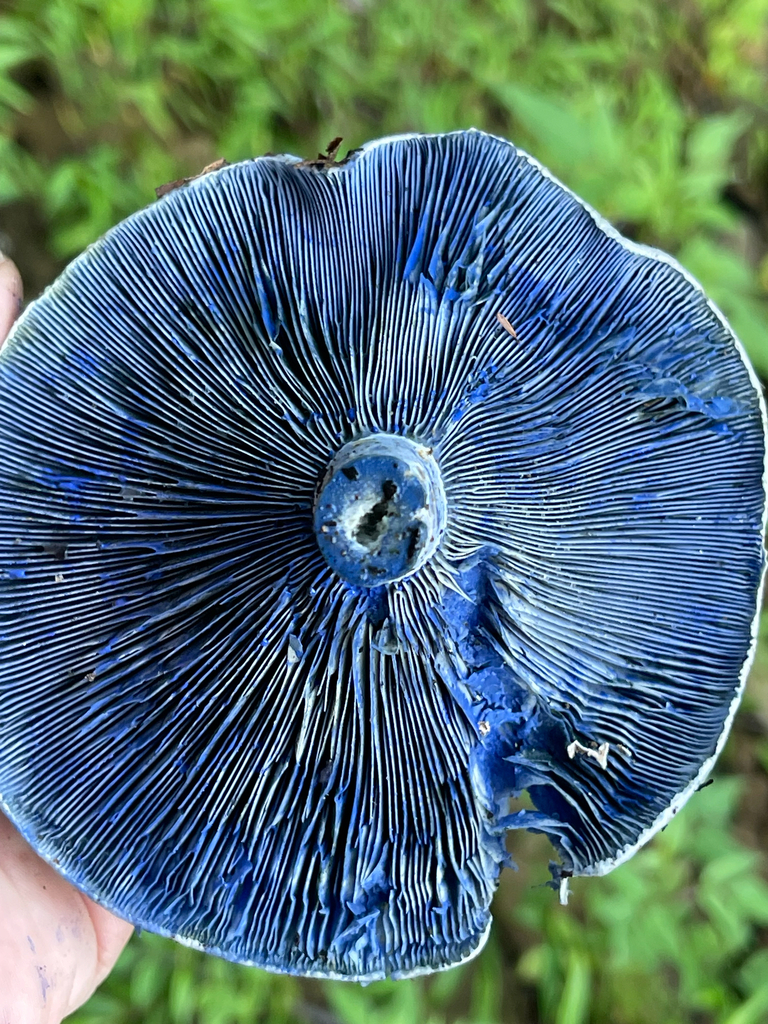
A mushroom may need more than its best-looking side. I photograph beneath the cap and around the stalk or stipe, looking for true gills, false gills, pores, a veil, texture, attachment, and any color change where the surface is handled or exposed.
Step back for the relationships.
A close-up can preserve a structure beautifully and still miss the fuller picture. The wider view shows whether the organism is growing from soil or wood, beside water or moss, beneath a particular canopy, or among other life in an interdependent habitat.
Leave room to keep learning.
No single photograph has taught me everything. I learn after almost every outing by revisiting the views, comparing details, following identification conversations, and noticing something in the frame that I did not understand when I made it.

June 15
The Orange Clusters Above the Cove
From the boat, it looked like a regular slough on Laurel Lake. The water was low, the feeder creek was not particularly wet, and at first there was not much to see beyond dry leaves. Nathan and I explored up the creek with the dogs for a while before a glimpse of orange caught my eye from about ninety yards away.
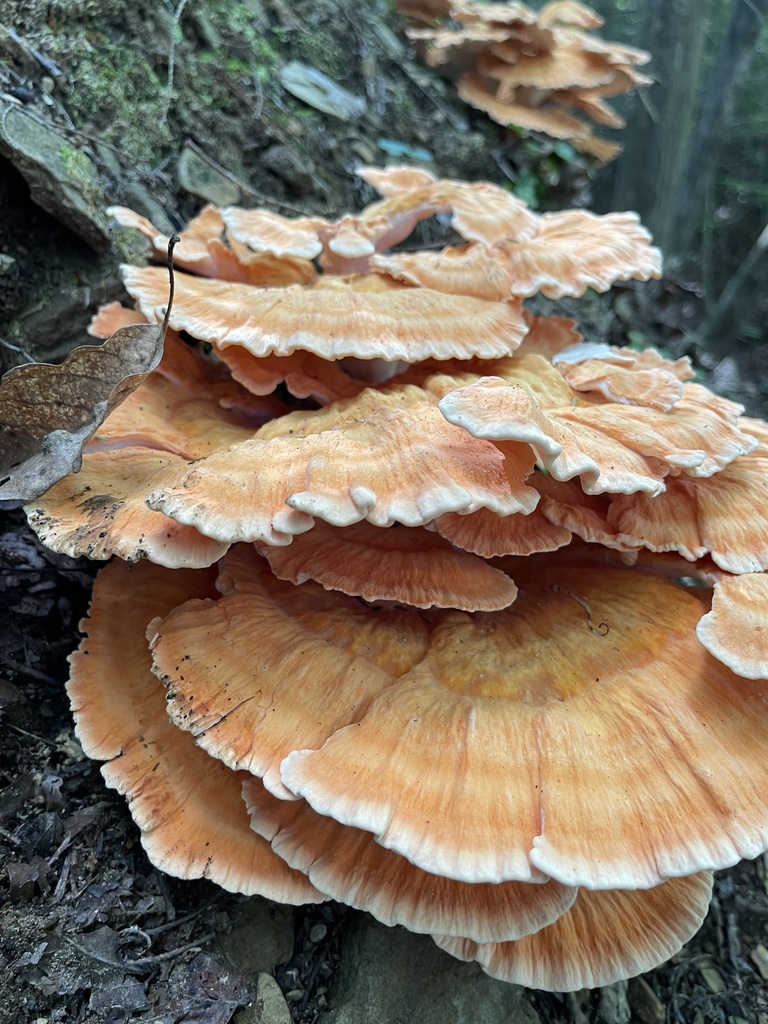
I kept moving closer. At sixty yards, the orange had resolved into something large enough that I knew I needed to climb toward it. I was hoping for fungus, and that is what it was: two enormous clusters of fully opened White-Pored Chicken of the Woods rising from the steep bank. I had wanted to see them for years. Why wouldn’t I climb?
The bank had been part of a prescribed-burn area and rose at an angle of roughly seventy degrees, sometimes steeper. I climbed barefoot, the way I often do on banks like this. Moss felt cool under my feet, and every step had to be deliberate. Nathan was right there with me, following straight up. I was so excited that the climb felt like nothing—until I turned around and realized how far we had come.
Up close, the clusters opened into broad, irregular shelves: saturated orange across the tops and white beneath, with folds and edges that seemed ready to become part of an artwork. Nathan is a chef, so the species’ culinary reputation made the encounter especially fun for him. I moved around the clusters with my camera, preserving their shape, pore surface, scale, and place on the bank. Those different views could serve a future composition, and they also gave other people better evidence for identification.
When I shared the photographs on Facebook, people quickly recognized the species, and a mycologist friend called it a very nice find. What stays with me most is the feeling of being blessed by its presence—the two giant orange clusters above us and hundreds of tiny chanterelles scattered around them.
Four ways into the record
Browse by organism, color, season, or method.
Choose the path that matches what you noticed or want to understand. Field stories can lead directly into the relevant guide entry.
Field Guide
Search the plants, fungi, animals, and other life in my photographs by common name, scientific name, or group.
Search the organisms →Color Guide
Begin with the color that caught our eye, then compare Field Views, habitat, identification history, and supported facts.
Explore living color →Seasons
See what entered my actual record from March through August without treating the record as a complete phenology survey.
Follow the calendar →The Record
Understand my observation totals, iNaturalist labels, documentation method, limits, and how I describe place and habitat.
Read the method →
June 5
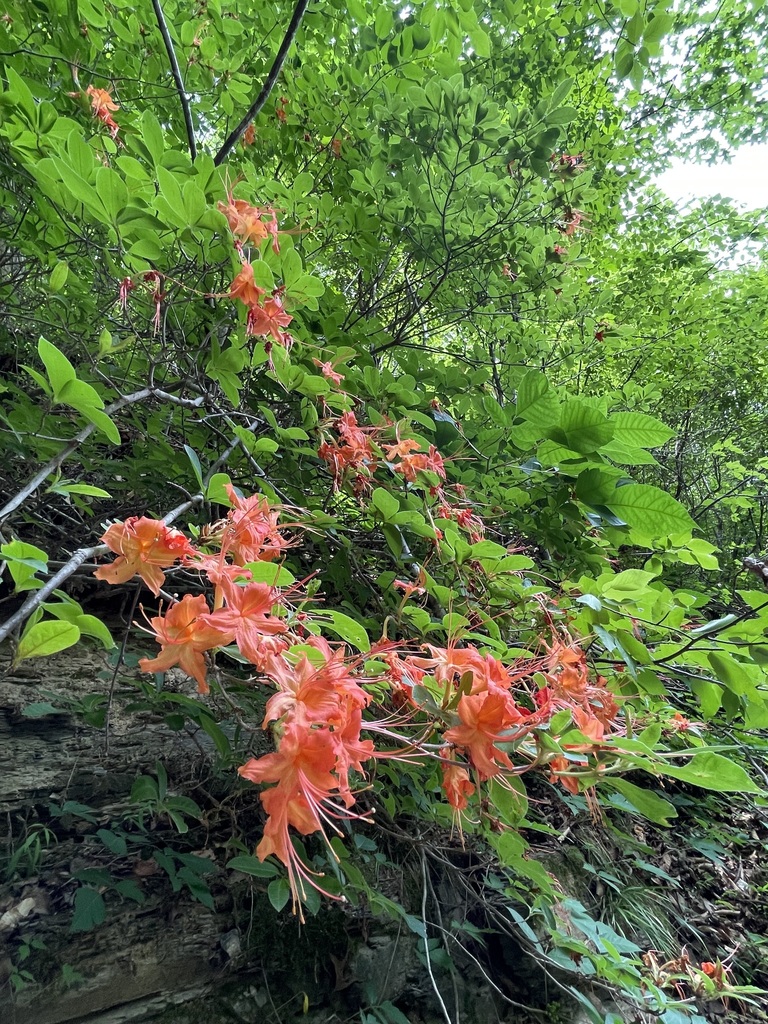
The Two Cumberland Azaleas
There was nothing else like them on the bank. One small shrub glowed from each side of the cove, and those are still the only two I have ever noticed. Their flowers moved through coral, reddish orange, and peach against green leaves and a dark, seepy shale bank. The long stamens reached beyond the petals and told me immediately that I was looking at something different.
Nathan was on the boat fishing while I watched the bank. He is usually holding a pole; I may be holding one too, but most of the time I am looking. To photograph the flowers closely, I climbed the rough, steep shale and held on where I could. Some of my field photographs are a little blurry because I am barely hanging on long enough to make them. Many are made with my phone, which is a good field camera when it is the camera I have.
I did not try to name the shrubs until I was home. An early automated suggestion offered Flame Azalea, but the timing and fully expanded leaves made me look further. My research and repeated community confirmation led to Cumberland Azalea, a later-flowering Appalachian species whose flowers open after the leaves have expanded. Learning its Kentucky history made the encounter feel even more rooted in this place.
When I shared the photographs on Facebook, people remembered seeing Cumberland Azaleas in childhood, wondered whether plants still bloomed on particular ridge tops, or spoke about relatives connected to those memories. Finding one in the wild already felt like treasure. Their stories made me feel connected to people who had also carried that color with them for years.
I could not stop thinking about the flowers, so they entered my artwork. I have used the palette freely without yet making a literal botanical portrait: orange against purple, because when I squint at a shaded brown bank, its shadows often lean violet, and violet makes the orange seem even brighter. The encounter became the reference for Cumberland Azalea on Purple Sandstone, and I know it will become more artwork.
How we explore
We choose a cove and start looking.
Nathan and I put our old boat in at the ramp with the dogs, then look for a secluded cove, a feeder creek, or a bank where they can run. When the water is low, we lift the motor and ease the bass boat into the shallows almost like a kayak.
The search has become more deliberate. Nathan studies tree groves from a distance and remembers where a seep or the right mix of hardwoods and evergreens may be. His experience as a forward observer trained him to find difficult targets by shape and silhouette. He often notices the smallest magnificent thing; I am more likely to catch a flash of color from across the cove.
I grew up at Laurel Lake and in the country around the Daniel Boone National Forest. Nathan grew up on the Florida coast, so he sees Kentucky with fresh eyes. We usually go in the late afternoon and stay until dark, watching the emerald water and wooded banks change with the light. A trip becomes “the one where we found” something new, and a cove becomes part of our shared map.
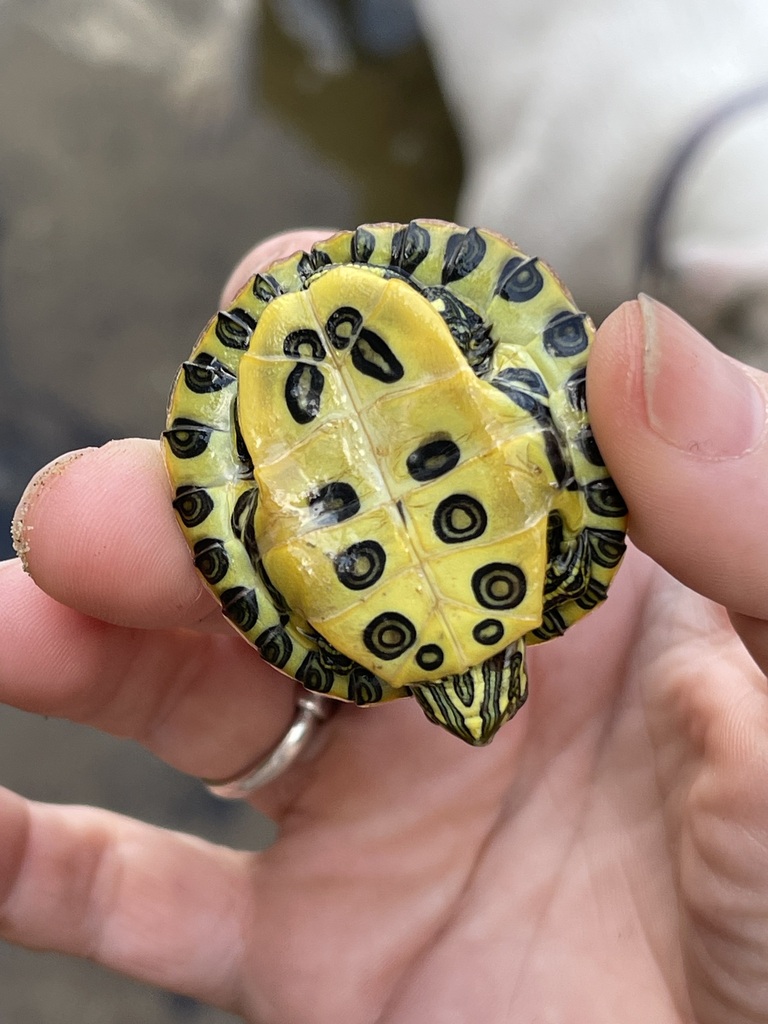
Even when the photographs do not come together, we remember eagles, deer, turtles, snakes, signs of beavers, and the sharp slap of a beaver’s tail against the water. There is a lot of marvel out there in the woods.
We are always together, so the observations are made together. I am grateful for Nathan, my husband, partner, and best friend—for keeping our old boat running, for the experience and knowledge he brings, and for being willing to climb barefooted up steep rocky banks with me to get closer to something with a flash of color. Ghost Pipes were all him, though.

August 1
A Fungi-Rich Day on the Forest Floor
We chose August 1 because rain was scattered through the forecast. My uncle taught me that overcast light can make color feel richer in photographs, and something magical happens in the forest just after rain. The leaves darken, the moss brightens, and forms that were easy to miss seem to rise from the wet ground and wood.
The whole outing became a back-and-forth of discoveries. It began with an unresolved bubblegum-looking fungus on a tree and a black slime mold. Then came a patch of brilliant Shaggy-Stalked Boletes, jelly fungi appearing on rain-darkened bark, Spindles, Oyster Mushrooms, blue mushrooms, and a wide range of boletes. We were looking for a patch of Small Chanterelles we had seen earlier, finding one thing after another on the way before finding the tiny golden chanterelles partly buried beneath the leaves.
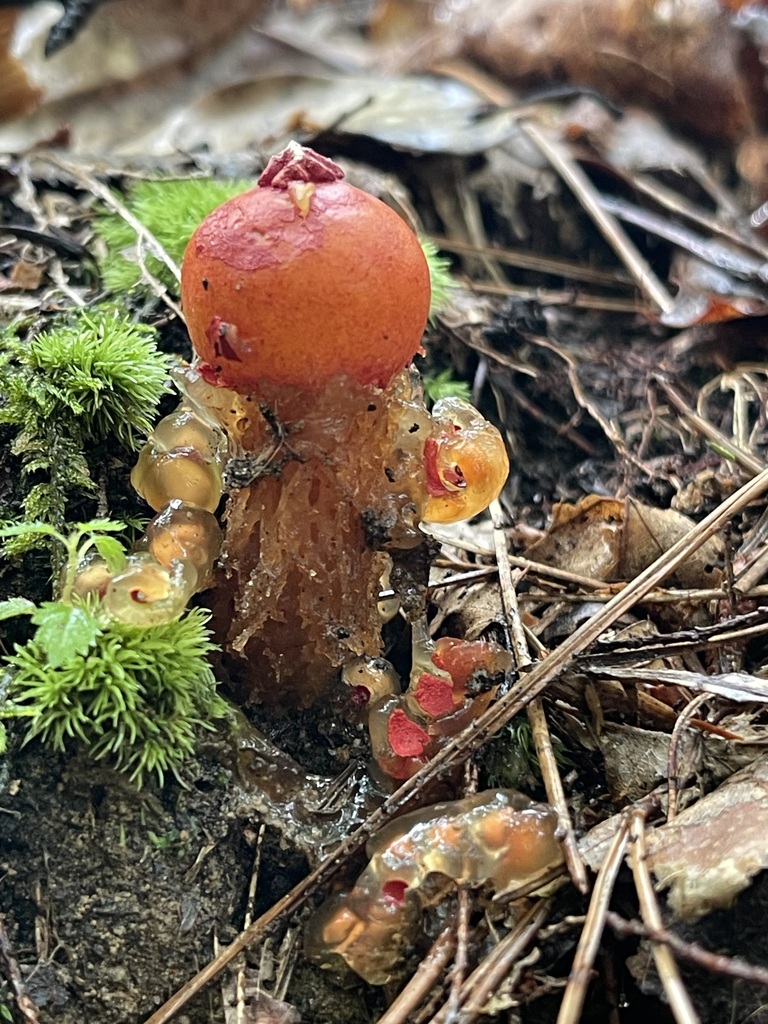
We also found a Mountain Camellia after bloom. Then I saw the first Stalked Puffball-in-Aspic. A red sphere stood above a ribbed stalk inside translucent amber jelly, like an alien creature placed among the moss. My first thought was simply, What can this be? The jelly looked soft enough to spread but felt firmer than I expected. Once we found the first one, we found three more.
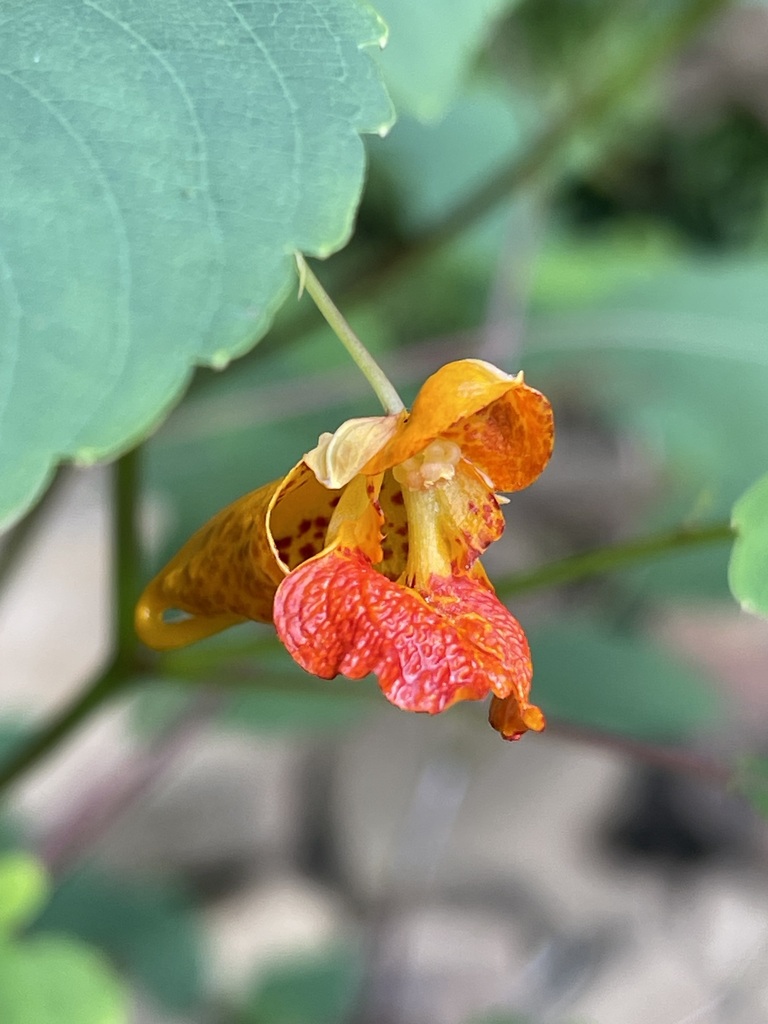
The day kept going: small rust-brown mushrooms with pointed scales, ferns still waiting for names, an Eastern North American Destroying Angel, and more forms tucked into wet wood and leaf litter. On our walk out, we found Jewelweed, fossils, a bright orange Eastern Newt, and a caterpillar that looked exactly like a twig and moved like an inchworm.
There was no real pause between encounters. I would finish documenting one, begin walking and looking again, and find the next. That wet day made one lesson impossible to miss: within stepping distance, there is probably something else.
What I hope you carry away
Notice one living thing.
I hope someone leaves this site, notices a flower on their next walk, photographs it with the app, and learns that it is native. Maybe knowing its name and place in the habitat makes them happy. Maybe it gives them one more reason to care about what grows around them.
You do not have to know every species by name before using iNaturalist. It is there to help with identification, and learning alongside other people is part of the fun. Taking one photograph with color and habitat in mind is easy, and a moment spent paying attention is never wasted.
These outings have taught me that familiar Appalachian places hold far more than Nathan and I realized. The same cove can change within twenty feet as light, moisture, rock, trees, and the life beneath them change. After several more seasons, I hope this record reveals even more life—and more people who care enough to notice it.
Looking closely now means giving one place enough time to become more than scenery: moving around it, seeing its relationships, learning a name when I can, and sharing what I found.