Wall art size guide

Canvas Size Comparison Guide for Wall Art

Square, vertical, horizontal, and panoramic canvas sizes shown with real lakehouse artwork so you can choose with less guessing.

Buying wall art online can feel strangely abstract. Use these visual canvas size comparisons as a starting point before measuring your own wall.

The question is not only "what size canvas should I buy?" It is also "what shape belongs on this wall?" Shape changes how the artwork feels long before the tape measure comes out.

Why this guide exists

Why I made these canvas size comparison guides

Choosing art should feel exciting, not like a guessing game.

When I started building Lakehouse Portrait Co., I realized how hard it can be to understand canvas sizes from numbers alone. Even when the dimensions are listed clearly, it can still be difficult to imagine the difference between nearby sizes, or to know whether a piece will feel quiet, balanced, or bold on a wall.

Most size guides online use plain rectangles or generic furniture diagrams. Those can help, but they do not always show what artwork actually feels like in a room. A painting with water, wildlife, flowers, shadow, and movement has a different presence than an empty box.

That is why these guides use actual lakehouse artwork from the shop.

The goal is simple: help you see the size relationships before you choose. A 12" square and a 36" square may share the same shape, but they do very different jobs. A tall panoramic canvas and a standard vertical canvas are both vertical, but they do not behave the same way on a wall. A wide panoramic piece can stretch across a space in a way a standard horizontal piece cannot.

These graphics are not meant to replace measuring your wall. They are meant to make the first decision easier: What shape fits the room? What size feels right? Do I want something small and intimate, or something that becomes part of the room itself?

Quick orientation overview

Start with the shape, then choose the size

Before choosing a canvas size, it helps to choose the shape that fits the wall. Size matters, but orientation changes everything.

Standard vertical canvas Best when you want height, a portrait-like feel, or artwork for narrower walls, bedrooms, reading nooks, and grouped arrangements.
Height without a wide wall
Standard horizontal canvas Best for classic landscape-style art over consoles, beds, desks, mantels, and smaller seating areas.
Classic landscape shape
Square canvas Best when you want balance, symmetry, and a simple shape that works well alone or in a gallery wall.
Balanced and flexible
Tall panoramic canvas Best for narrow vertical spaces where you want height without taking over too much wall width.
Slim vertical drama
Wide panoramic canvas Best for long walls, sofas, beds, sideboards, dining areas, lake rooms, and places where the artwork needs to stretch across the room.
Long wall presence

If you are deciding between two sizes, consider both the wall and the role of the artwork. Is it an accent, a supporting piece, or the main piece in the room?

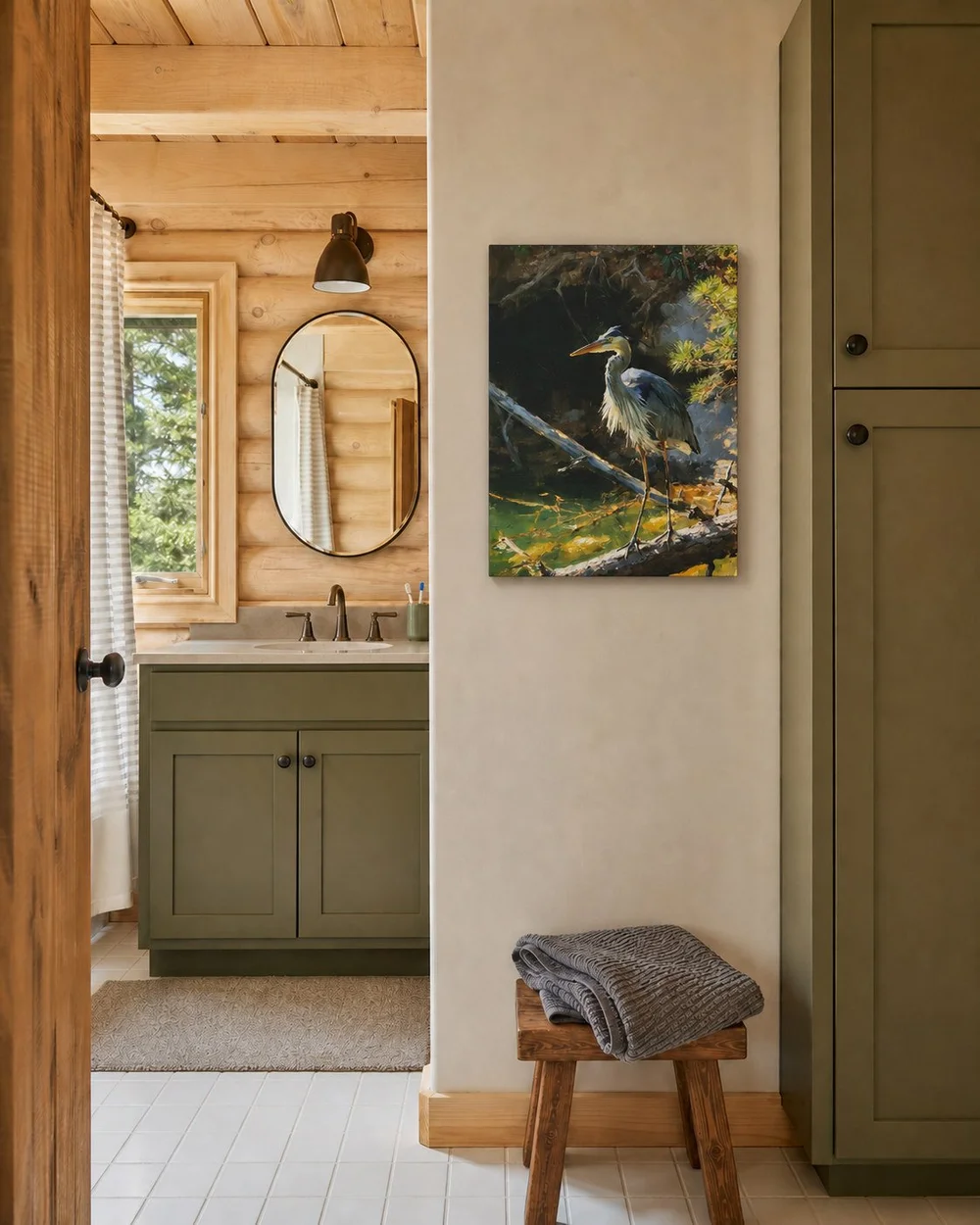
Standard vertical canvas size comparison guide showing 11 x 14, 16 x 20, 18 x 24, 24 x 30, and 30 x 40 gallery wrapped canvas sizes with Great Blue Heron on Lake Keowee artwork.
Approximate visual size comparison for standard vertical gallery wrapped canvas sizes.

Standard vertical

Standard vertical canvas size comparison

For portrait-like artwork, birds, wildlife, and narrow wall spaces.

Standard vertical canvases are useful when you want height without needing a very wide wall. They work well for wildlife pieces, bird artwork, and scenes where the subject has a natural upright presence.

This guide is especially helpful when comparing smaller vertical sizes with larger statement sizes. An 11" x 14" canvas can feel personal and easy to place, while a 30" x 40" canvas has enough presence to anchor a bedroom wall, reading corner, entryway, or lake room.

Standard vertical pieces can also work well in pairs, narrow wall sections, hallway ends, or gallery-style groupings. If your space has more height than width, this is often the easiest orientation to begin with.

Great Blue Heron on Lake Keowee A quiet vertical lake scene featuring a great blue heron standing along the water's edge, with deep greens, reflected light, and the stillness of a bird encountered near shore.
  • Do I need a small accent or a main wall piece?
  • Will this vertical artwork feel too narrow for the wall?
  • Should I go one size larger for more presence?
Standard horizontal canvas size comparison guide showing 14 x 11, 16 x 12, 20 x 16, 24 x 18, and 30 x 24 gallery wrapped canvas sizes with Azalea Bend in High Water artwork.
Approximate visual size comparison for standard horizontal gallery wrapped canvas sizes.

Standard horizontal

Standard horizontal canvas size comparison

For classic landscape-style wall art and medium-width spaces.

Standard horizontal canvases are one of the most familiar wall art shapes. They fit naturally above a small console, desk, dresser, mantel, bed, or compact seating area.

This shape works well when the artwork has a landscape feeling but does not need the extra width of a panoramic canvas. It gives the room a sense of calm movement without stretching too far across the wall.

The size comparison is useful because the smallest sizes can feel charming and collectible, while the larger sizes begin to hold the wall more confidently. A 14" x 11" canvas might be right for a shelf, small wall, or grouped display. A 30" x 24" canvas feels more like a finished focal point.

Azalea Bend in High Water A reflective shoreline scene with bright azalea blooms, blue-green water, a quiet turtle near the bank, and the feeling of a hidden bend along the lake.
  • Is this piece meant to stand alone or join a gallery wall?
  • Do I want a modest horizontal piece or a stronger focal point?
  • Will this fit better than a wide panoramic canvas?
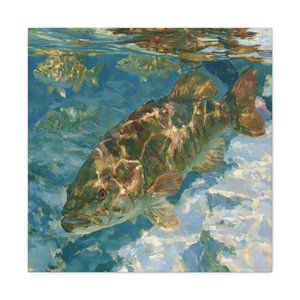
Square canvas size comparison guide showing 12 x 12, 24 x 24, and 36 x 36 gallery wrapped canvas sizes with Smallmouth Bass in Clear Water artwork.
Approximate visual size comparison for square gallery wrapped canvas sizes.

Square

Square canvas size comparison

For balanced wall art, gallery walls, and statement square pieces.

Square canvases are simple, balanced, and surprisingly flexible. They can feel modern without being cold, and they are easy to use alone or as part of a larger arrangement.

The square guide is useful because square art gains presence quickly. A 12" x 12" canvas is small, charming, and easy to tuck into a narrow wall, shelf area, bathroom, hallway, or gallery grouping. A 24" x 24" canvas feels much more substantial. A 36" x 36" canvas becomes a true statement piece.

Square artwork can also be a good choice when you are not trying to match the shape of furniture exactly. It can float above a console, sit between windows, balance a reading nook, or become the center of a collected wall.

Smallmouth Bass in Clear Water A clear-water fish painting with smallmouth bass moving beneath the surface, blue-green water, golden markings, and sunlit reflections.
  • Is 12" x 12" too small for my wall?
  • How much bigger does 24" x 24" feel?
  • Do I want a balanced statement piece instead of a long horizontal one?
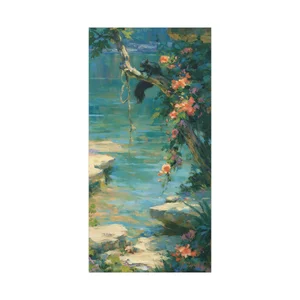
Tall panoramic canvas size comparison guide showing 10 x 20, 15 x 30, 20 x 40, 24 x 48, and 30 x 60 vertical gallery wrapped canvas sizes with Cumberland Azalea and Black Squirrel artwork.
Approximate visual size comparison for tall panoramic gallery wrapped canvas sizes.

Tall panoramic

Tall panoramic canvas size comparison

For narrow vertical spaces that need height, drama, and softness.

Tall panoramic canvases solve a different problem than standard vertical art. They are slim, tall, and atmospheric. They can bring height to a room without needing a wide wall.

This shape is especially useful for spaces that feel too narrow for traditional artwork: stair landings, hallway ends, entry walls, spaces between windows, beside a doorway, near a reading chair, or anywhere the room needs a vertical gesture.

The guide helps show how dramatic the size shift can be. A 10" x 20" canvas feels delicate and easy to place. A 30" x 60" canvas becomes a tall statement, almost like a window into the artwork.

Cumberland Azalea & Black Squirrel: Among Rare Things A tall, luminous lake-edge scene with turquoise water, Cumberland azalea blooms, sandstone, and a black squirrel perched among the branches.
  • I have a narrow wall. What size could work?
  • Do I want height without too much width?
  • Would a tall panoramic piece feel more intentional than a standard vertical canvas?
Wide panoramic canvas size comparison guide showing 20 x 10, 30 x 15, 40 x 20, 48 x 24, and 60 x 30 horizontal gallery wrapped canvas sizes with High Top Evening Daisies artwork.
Approximate visual size comparison for wide panoramic gallery wrapped canvas sizes.

Wide panoramic

Wide panoramic canvas size comparison

For long walls, lake rooms, sofas, beds, sideboards, and statement spaces.

Wide panoramic art is often the hardest size to imagine online because the difference between a small panoramic piece and a large one is dramatic.

A 20" x 10" canvas feels like an accent. A 40" x 20" canvas begins to feel more substantial. A 60" x 30" canvas can become the main piece in a room.

Wide panoramic canvases are especially helpful over long furniture or open walls: sofas, beds, sideboards, dining benches, mantels, lake room walls, and places where a standard horizontal canvas may feel too compact.

This shape can make a room feel calmer and more expansive because the artwork carries the eye horizontally. It is a natural fit for lake scenes, shorelines, sunsets, water reflections, and long landscape compositions.

High Top Evening Daisies A wide evening lake scene with soft daisies, reflective water, shoreline grasses, distant trees, and a warm sunset glow.
  • Do I need a panoramic piece for a long wall?
  • Is 60" x 30" too big, or is it the size that finally fits the space?
  • Would a wide canvas feel better over furniture than a standard horizontal piece?

Canvas price note

How size affects canvas price

Canvas prices usually increase with size because larger pieces use more material, print surface, stretcher depth, packaging, and shipping space. Since shipping is included, the listed price reflects the finished gallery-wrapped canvas arriving ready to hang.

Prices may vary by artwork and size. For the most current price, visit the individual artwork page.

Canvas type Helpful example sizes Starting at
Small accent canvas 12" x 12", 14" x 11", 10" x 20" $59
Flexible medium canvas 16" x 20", 20" x 16", 24" x 24" $99
Statement canvas 30" x 40", 36" x 36", 60" x 30" $199
Premium gallery wrap canvas depth guide showing wrapped canvas sides, finished mirrored edges, and ready to hang construction.
Gallery wrapped canvas depth guide. Use the product page for the exact finish and current size options.

How to use the guides

How to use a canvas size comparison guide

Start by choosing the shape that fits your wall. Then compare the sizes within that shape.

Small Small sizes are often best for shelves, narrow walls, bedrooms, bathrooms, gallery walls, small nooks, and quiet corners.
Medium Medium sizes are the most flexible. They can stand alone on smaller walls or become part of a larger room arrangement.
Large Large sizes work best when the artwork is meant to anchor the space. These are the pieces that begin to feel like part of the room, especially over a bed, sofa, mantel, sideboard, or main lake room wall.

If you are between two sizes, I usually lean toward the size that gives the artwork room to breathe. A piece that feels slightly generous often looks more intentional than one that feels timid on the wall.

But the best choice still depends on the room. Measure the wall, consider the nearby furniture, and think about whether you want the artwork to whisper, support the room, or become the first thing someone notices.

These guides are approximate visual comparisons. They are meant to help you understand the relationship between sizes, but every room is different. Before ordering, measure your wall and check the product dimensions listed on the artwork page.

Canvas size questions

Canvas size questions people ask before choosing wall art

Short answers for the part of shopping where the numbers are clear, but the wall still feels hard to picture.

What canvas size should I choose if I do not know how big the art will feel on my wall?

Start with the wall shape first. If the space is tall and narrow, look at vertical or tall panoramic art. If the space is wide, look at horizontal or wide panoramic art. If the space feels balanced or square, a square canvas may be the easiest fit.

Once the shape feels right, compare the sizes inside that shape. Smaller sizes are good for quiet corners and grouped spaces. Larger sizes are better when you want the artwork to feel intentional from across the room.

What is the difference between a small canvas, a medium canvas, and a statement-size canvas?

A small canvas usually feels personal and close-up. It works well in bedrooms, shelves, hallways, bathrooms, small walls, or gallery groupings.

A medium canvas is more flexible. It can stand alone on a smaller wall or support a larger room without taking over.

A statement-size canvas is meant to hold attention. It works best when the artwork is the main piece over a bed, couch, mantel, sideboard, or open wall.

Is 12" x 12" too small for wall art, or does it still work in certain spaces?

A 12" x 12" canvas is not too small if it is used in the right place. It may feel too small over a large sofa or bed, but it can be beautiful on a narrow wall, shelf, small hallway, bathroom, reading nook, or as part of a gallery wall.

Small art works best when it feels intentional, not stranded.

How much bigger does a 24" x 24" canvas feel compared with a 12" x 12"?

A 24" x 24" canvas is twice as wide and twice as tall as a 12" x 12", so it feels much more substantial on a wall. It is not just a little bigger. It has four times the surface area.

That is why the jump from 12" square to 24" square can feel so dramatic in a room.

What size canvas works best over a console table, couch, bed, mantel, or sideboard?

It depends on the furniture and the wall, but larger horizontal or panoramic pieces usually work better over long furniture. A small canvas can look lovely nearby, but over a couch, bed, mantel, or sideboard, you usually want the artwork to have enough width to feel connected to the furniture below it.

For long walls or larger furniture, look at standard horizontal or wide panoramic sizes first.

When should I choose a square canvas instead of a vertical or horizontal canvas?

Choose a square canvas when you want balance. Square art does not lean strongly tall or wide, so it can work in places where a rectangle feels awkward.

Square canvases are good between windows, over small furniture, in gallery walls, in reading corners, or anywhere you want the artwork to feel centered and steady.

What is the difference between standard vertical art and tall panoramic vertical art?

Standard vertical art has a more familiar portrait shape. It gives height, but it still has enough width to feel grounded.

Tall panoramic vertical art is slimmer and more dramatic. It works well when you need height but do not have a wide wall. It can feel almost like a window into the scene.

Why does wide panoramic art feel so different from regular horizontal wall art?

Wide panoramic art stretches the eye across the wall. It feels more expansive, especially with lake scenes, shorelines, sunsets, and water reflections.

A regular horizontal canvas is easier to place in smaller spaces. A wide panoramic canvas is better when you want the artwork to span a wall or connect with long furniture below it.

Can smaller canvases still look intentional in bedrooms, hallways, shelves, nooks, bathrooms, or gallery walls?

Yes. Smaller canvases can look very intentional when they are placed where close viewing makes sense.

They work best in spaces people pass through slowly or see up close: a hallway, bedside wall, shelf, desk area, bathroom, reading nook, or grouped collection. The key is not asking a small canvas to do the job of a large one.

How do I choose between two nearby sizes, like 16" x 20" and 18" x 24", or 24" x 30" and 30" x 40"?

If the two sizes are close, think about the job of the artwork.

If it is going in a small room, shelf area, hallway, or gallery wall, the smaller option may be enough. If it is meant to stand alone or anchor a wall, the larger option usually feels more finished.

When I am unsure, I look at whether the art needs to be noticed from across the room. If it does, I usually lean larger.

Ready to choose

Ready to choose the canvas that fits your room?

Once you have a feel for the size and shape, you can browse the canvas collection by artwork, subject, room, or mood. Each piece includes its available sizes so you can choose the version that fits your wall and the way you want the room to feel.

The right size is not just about filling a wall. It is about giving the artwork enough room to feel at home.