
Field Notes & Community Science
An Artist’s Appalachian Color Guide
An Appalachian rainbow in natural colors—photographed in flowers, fungi, fish, insects, lichen, and the changing greens of the forest.
Mountain Laurel · May · Rachel Stepek
An Appalachian rainbow in natural colors
The mountains have their own rainbow.
I’m an Appalachian artist who has almost always had a camera in my hand. These photographs began as references for my artwork, then grew into a field record of the plants, fungi, animals, and lichens Nathan and I encounter around Kentucky Appalachian coves and forest floors. Color is often what stops me first: cardinal red on a bank, lemon yellow beneath a mushroom cap, or an Indigo Milk Cap which bleeds blue.
The photographs move from vibrant reds through orange and gold, then from yellow-green into blue and indigo. Violet warms toward pink before the rainbow settles into white, cream, earth brown, gray, charcoal, and black—the quieter colors of the same coves and forest floors.
The Appalachian spectrum
Red
cool crimson · cardinal · berry · rust · coral · red-orange
Red begins with the vibrant Cardinal Flower, then moves into the ruby-red globes of Stalked Puffball-in-Aspic before warming through berry, rust, coral, and red-orange at the edge of Orange.
Cardinal red
Cardinal Flower
Lobelia cardinalis
Tiered cardinal-red flowers climb a tall green stem, each narrow tube opening into sharp lower lips and curling side petals. Broad leaves frame the close views in saturated green; farther back, the complete flower spike rises against gray sandstone, woodland shade, and the quiet water of the cove.
Research Grade
Field fact and source
Red-orange
Stalked Puffball-in-Aspic
Calostoma cinnabarinum
Ruby-red spore sacs rise from translucent amber bases that gleam like wet resin among bright moss. One mature globe opens in a dark, star-shaped mouth; other views reveal a tall stalked form, crowded scarlet colonies, and an ivory immature cluster whose gelatinous lobes are still tightly folded.
August · Research Grade
Field fact and source
Cool crimson
Fire Pink
Silene virginica
Scarlet flowers flare from the rocky forest floor, each five-petaled face split into long, deeply notched points. Their slender green stems thread through gray bark, weathered sticks, brown leaf litter, and the first soft green growth of the season.
April · Research Grade
Field fact and source
Berry red
Red Raspberry Slime Mold
Tubifera ferruginosa
Tiny raspberry-red beads crowd inside a split in silvered, decaying wood. Some are round and glossy while others lengthen into minute coral fingers, their vivid color concentrated in the dark, damp seam of the log.
June
Field fact and source
Fruit red
Partridgeberry
Mitchella repens
Scarlet fruits glow like small polished beads above a creeping mat of round, deep-green leaves. Moss, bronze leaf fragments, tiny stems, and damp soil make the berries feel even brighter at forest-floor scale.
Research Grade
Field fact and source
Dark rust red
Powder-Scale Pholiota
Flammulaster erinaceellus
Small cinnamon-red caps cluster from the side of a fallen log, their darker centers densely dusted with upright scales. The caps thin toward translucent ember-orange rims above rusty gills, wet brown leaves, and a fine green film of moss.
August
Field fact and source
Coral red
Brittlegill
Russula
A smooth coral-red cap rises on a clean ivory stalk, its center deepening toward warm carmine and its rim paling softly. Dry oak leaves, charcoal twigs, and gray stones surround the mushroom with the subdued browns of the forest floor.
August
View the iNaturalist observationRed-orange
Field Bolete
Hortiboletus campestris
The rounded cap is a soft red-orange, matte and almost velvety, above a stalk that begins golden yellow and deepens through rust to wine red at the base. Curled wet leaves, dark wood, and one bright green seedling gather around the upright mushroom.
August
View the iNaturalist observationThe Appalachian spectrum
Orange
red-orange · coral · tangerine · safety orange · amber
Orange opens close to red, expands through flowering coral and fungal peach, then reaches amber and yellow-orange.
Coral orange
Cumberland Azalea
Rhododendron cumberlandense
Apricot-orange flowers deepen to coral along their ruffled, starry edges, with long rust-red stamens reaching well beyond the petals. The loose clusters spill over a layered rock bank among fresh green leaves, gray ledges, and the darker foliage of the woods.
June
Field fact and source
From field observation to artworkSee Cumberland Azalea on Purple Sandstone →
View the iNaturalist observationPeach to warm orange
White-Pored Chicken of the Woods
Laetiporus cincinnatus
Broad salmon-orange shelves stack into rippling rosettes, each fan banded with peach and finished by a narrow cream edge. Close views reveal velvety upper surfaces and a chalk-white pore layer; on the steep wooded bank, light passes through the thinner margins above dark roots, stone, and moss.
June · Research Grade
Field fact and source
Red-orange
Red Chanterelle
Cantharellus cinnabarinus
A tiny cinnabar-red chanterelle lifts a curled, irregular cap above a short orange stalk. Apricot ridges appear beneath the folded edge, while gravel, splintered sticks, gray stones, and dark soil make the small flare of color easy to measure.
July · Research Grade
Field fact and source
Tangerine
Common Jewelweed
Impatiens capensis
The blossom hangs like a small tangerine pouch, freckled with brick-red spots and tapering into a delicate curved spur. A butter-gold hood folds over the opening, while thin succulent stems and broad blue-green leaves soften the shaded lakeshore around it.
Research Grade
Field fact and source
Brilliant orange
Eastern Newt
Notophthalmus viridescens
This saturated orange eft is the Eastern Newt’s terrestrial teenager—a juvenile stage spent walking the forest floor before returning to water as an adult. Its curling tail, black-ringed spots, pebbled skin, tiny feet, and narrow toes stand out against cream, rust, and blue-gray creek stones.
Research Grade
Field fact and source
Orange to yellow
Orange-Gilled Waxcap
Humidicutis marginata
A glossy tangerine-orange cap arches above closely spaced gills of the same saturated hue. The slender stalk fades toward lemon yellow, and a fingertip beside the mushroom sets its delicate size against curled brown leaves and damp soil.
August · Research Grade
View the iNaturalist observationAmber to yellow-orange
Orange Jelly Spot
Dacrymyces chrysospermus
Marigold-orange folds gather on rain-darkened bark like small translucent ruffles. Their glossy, gelatinous surfaces catch the light at close range, while the wider view reduces them to brilliant pinpoints on a slender charcoal-brown trunk.
August
Field fact and source
Tawny orange · pearl silver
Great Spangled Fritillary
Argynnis cybele
Folded wings carry large pearl-silver windows across cinnamon brown and tawny orange. With each turn, the upper wings open into brighter orange panes divided by black lines, while dusty pink flower clusters and broad green leaves place the butterfly among its late-summer colors.
August
View the iNaturalist observationThe Appalachian spectrum
Yellow & Gold
ochre · old gold · butter · clear yellow · lemon · yellow-green
Gold and ochre come first. Butter, clear yellow, and lemon follow before the last small flowers lean toward green.
Ochre to old gold
Shaggy-Stalked Bolete
Aureoboletus betula
Old-gold caps shade toward ochre-orange, their rims lit from below by a dense lemon-yellow pore surface. The thick, curving stalks are wrapped in a deeply raised yellow network streaked with rust and red, almost like open latticework. Moss, silver-green lichen, oak leaves, and twigs crowd the low shelter around them.
August · Research Grade
Field fact and source
Rich golden yellow
Ornate-Stalked Bolete
Retiboletus ornatipes
The late-August mushroom stands whole above dry leaves: a smooth sunflower-yellow cap balanced on an even brighter stalk wrapped in a deeply raised gold network. The earlier hand-held view turns the cap over to show a fine, evenly yellow pore surface.
July & August · Forest Floor · Research Grade
Field fact and source
Cream gold
Golden-Gilled Gerronema
Gerronema strombodes
Creamy golden gills radiate from a tiny center and run down a threadlike amber stalk. The mushrooms spring from blackened, water-dark wood, where a hand, patches of moss, and the charred grain make their cream undersides look almost luminous.
August · Research Grade
View the iNaturalist observationGolden yellow
Small Yellow Mushrooms
Hydnaceae
One egg-yolk-yellow mushroom rises cleanly through crossed pine needles, its wavy cap opening above a narrow golden stem. Blunt ridges run beneath the cap while wet brown leaves, black soil, and scattered orange fragments repeat the color across the forest floor.
August
View the iNaturalist observationHoney ochre
Fibroporia
Fibroporia radiculosa
A honey-ochre crust spreads beneath decaying wood in thick shelves and dense fields of downward-pointing teeth. Creamy tips catch the light along each ragged fold, framed by black cavities, splintered bark, and saturated green moss.
August · Research Grade
View the iNaturalist observationButter yellow
Appalachian Tiger Swallowtail
Papilio appalachiensis
Lemon-yellow wings repeat across the damp floor of a rock shelter, every butterfly crossed by bold black tiger stripes. Open triangles, folded profiles, and flashes of powder blue gather among wet stone, fallen leaves, and the dark sandstone ledge below the waterfall.
April
Field fact and source
Butter yellow
Eastern Tiger Swallowtail
Papilio glaucus
Lemon-yellow wings open into a broad, angular silhouette crossed by four velvety black stripes. Powder-blue crescents and two burnt-orange eyespots brighten the tailed hindwings, while sandy gray ground and a few grass blades keep the butterfly’s full span visible.
July · Research Grade
Field fact and source
Clear yellow
Southern Sneezeweed
Helenium flexuosum
A rounded wine-brown disk rises above a skirt of clear yellow rays, each petal ending in three neat notches. The flower faces the lens on a slim green stem, with smaller blooms, wet-bank foliage, and softly blurred pink-purple plants behind it.
June
Field fact and source
Lemon, cream and black
Yellow-Striped Oakworm Caterpillar
Anisota peigleri
Lemon-yellow stripes run the length of the caterpillar’s black body between rows of dark branching spines. Cream markings, tiny orange-brown feet, a narrow twig, and springy olive moss make the close views a layered study in line and texture.
August
Field fact and source
Vivid lemon yellow
Fragile Dapperling
Leucocoprinus fragilissimus
A pointed lemon-yellow cap balances on a stem nearly as thin as grass. The upright views emphasize its clean, high-key color among russet leaves; turned on its side, the mushroom reveals delicate ivory gills and a papery cap margin.
August · Research Grade
View the iNaturalist observationLemon yellow
Club-Like Tuning Fork
Calocera cornea
Hundreds of egg-yolk-yellow clubs branch into tiny forks across a slick, almost black log. The upright tips resemble miniature antlers or flames, spreading in loose colonies through beads of moisture, bare wood grain, and shadow.
June
Field fact and source
Lemon yellow
Dwarf St. John's Wort
Hypericum mutilum
Minute butter-yellow flowers open into five-pointed stars above wiry green stems and paired narrow leaves. Resting across a hand, the plant’s true scale becomes clear against bright shoreline growth, scattered stone, and a damp woodland bank.
June
Field fact and source
Yellow-green
Downy Yellow False Foxglove
Aureolaria virginica
A single yellow bell hangs beneath a vertical run of round chartreuse buds on a tall green stem. Against gray bark and a leaf-strewn slope, the small bloom is easy to miss until its clear yellow catches the eye.
June
Field fact and source
The Appalachian spectrum
Green
yellow-green · olive · leaf · fern · forest · blue-green
The Red-Eared Slider’s luminous underside opens Green. Olive shell, patterned mosses, leaves, fern, lichen, and finally the Luna Moth carry the chapter toward blue-green.
Yellow-green to olive
Red-Eared Slider
Trachemys scripta elegans
Curled tightly on an open palm, the young turtle becomes a fist-sized spiral of deep olive shell, fine yellow lines, striped skin, and one vermilion mark behind the eye. Another view turns it over to reveal a luminous yellow-green underside patterned with dark rings and brushmarks.
July · Research Grade
Field fact and source
Sunlit yellow-green
Broom Forkmoss
Dicranum scoparium
Sunlight turns the dense moss cushion chartreuse, picking out swept, needlelike leaves and a thicket of fine golden stalks. Wider photographs follow the same yellow-green across roots, dark soil, scattered trees, and the moss-covered lakeside slope above gray water.
June
View the iNaturalist observationFresh yellow-green
Cucumber Root
Medeola virginiana
A star-shaped whorl of smooth apple-green leaves opens above deep moss, each pointed blade marked by a fine central vein. Wet copper-brown leaves, decaying wood, and several different moss textures surround the small plant in a richly layered patch of forest floor.
July · Research Grade
Field fact and source
Coral-edged yellow-green
American Alumroot
Heuchera americana
Round, softly scalloped leaves spread across gray sandstone, their lime-green centers feathering outward into coral-pink and wine-red margins. Younger and older leaves carry different balances of the same colors above a small burgundy rosette and dry brown litter.
August
View the iNaturalist observationFresh lime green
Meadow Spikemoss
Selaginella apoda
Cool lime-green stems branch across wet stones in flat, repeating fans. Tiny overlapping leaves give every stem a finely scaled edge, while gray pebbles, dark twigs, and a few broad woodland leaves reveal how close this intricate patch lies to the ground.
August
Field fact and source
Deep emerald green
Greater Whipwort
Bazzania trilobata
Glossy emerald shoots pack together in overlapping three-pointed fans, each one built from rows of minute scale-like leaves. Water beads across the surface and sinks into the narrow seams, sharpening the pattern from spring green highlights to forest-dark shadows.
August · Research Grade
View the iNaturalist observationFern green
New York Fern
Amauropelta noveboracensis
One fully opened fern-green frond fills the frame, broad through the middle and tapering cleanly at both ends. Its narrow leaflets divide into crisp, feathered lobes above dark moss, curled brown leaves, crossed twigs, and softly blurred ferns farther up the slope.
July
Field fact and source
Deep forest green
Striped Wintergreen
Chimaphila maculata
Dark evergreen leaves rise from wet copper leaf litter, each pointed blade drawn with a bold silver-white midrib and branching veins. Cream-white nodding buds lift above the rosette in the foreground; beyond a mossy fallen log, Callie pauses among the gray trunks and looks back toward the camera.
May · Research Grade
Field fact and source
Cool gray-green
Mountain Spleenwort
Asplenium montanum
Blue-green fronds spill from damp sandstone in narrow, intricately divided fans. Their tiny rounded leaflets press against rust-streaked rock, silver-green lichen, and dark crevices, with wider views showing the fern repeated across the cool stone face.
Research Grade
Field fact and source
Cool lichen green
Rock Greenshield Lichen
Flavoparmelia baltimorensis
A broad patch of silver-sage lobes spreads over charcoal stone, its edges curling into soft, shieldlike ruffles. The center is rough with clustered bumps and gray-green granules, giving the lichen a dense texture against the smoother rock.
July
Field fact and source
Silver blue-green
Luna Moth
Actias luna
A Luna Moth shelters from the rain by gripping the underside of a fern, its powdery blue-green wings pressed beneath the fronds and its long tails hanging into the leaf litter. Lavender eyespots and fine veins emerge in the closer views; from below, canopy light turns the wings translucent above Rachel’s upturned face.
August · Research Grade
Field fact and source
The Appalachian spectrum
Blue & Indigo
sage blue-green · teal · turquoise · cyan · clear blue · denim · indigo · powder blue · blue-violet
The sequence begins at sage blue-green, then moves through teal lichen, turquoise fish, clear blue, and stormy denim. The Indigo Milk Cap deepens the middle of the chapter before powder-blue and violet-blue flowers carry it toward Violet.
Sage blue-green · ivory
Blue-green Cracking Russula
Russula parvovirescens
A broad sage-blue cap breaks into cream-edged islands like old glaze crazing across a ceramic surface. One torn wedge turns upward to reveal clean ivory gills, sharpening the cool blue-green against dark soil and copper-brown leaves.
August
View the iNaturalist observationTeal to blue-green
Smokey-Eyed Boulder Lichen
Porpidia albocaerulescens
A round blue-green thallus drapes over a mossy boulder like a cool mineral wash. Hundreds of raised charcoal disks stipple the mint surface, while a twig, bright green moss, and splintered brown wood define the lichen’s broad scale.
August · Research Grade
View the iNaturalist observationTurquoise blue
Longear Sunfish
Lepomis megalotis
Turquoise lines curl across the cheek and gill cover, breaking into tiny blue flecks over olive-gold scales. The belly warms through yellow to orange, the eye glows red, and an open hand suspends the small fish above deep green water and the red edge of the boat.
June · Research Grade
View the iNaturalist observationCyan-blue
Bluegill
Lepomis macrochirus
Steel blue and cyan wash across the cheek and gill cover, cooling into olive, bronze, and charcoal over the patterned body. A dark fin spreads below the hand, while green water, reflected sky, and the red boat edge surround the fish with deeper versions of its color.
June · Research Grade
View the iNaturalist observationClear sky blue
Azure Bluet
Houstonia caerulea
Four powder-blue petals form tiny pinwheels around pinpoint yellow centers. Thread-thin stems lift the flowers only slightly above golden moss, curled brown leaves, and broad green foliage, making their powder-blue color feel both delicate and unmistakable.
April · Research Grade
Field fact and source
Denim blue · storm blue
Entoloma indigoferum
Entoloma indigoferum
A round cap appears painted in stormy denim, darkest at its softly depressed center and dusted with tiny silver flecks. Low views turn the cool surface over to reveal warm gray-pink gills and a slender blue-gray stalk.
August
View the iNaturalist observationDeep indigo
Indigo Milk Cap
Lactarius indigo
Turned upward, the broad gills radiate in saturated indigo, shifting from silvery blue at the rim to ink-dark cobalt where they gather around the stalk. The cap above is a powder blue among fern stems and wet leaves. Broken edges release blue milk, staining the damaged gills an even deeper blue.
August · Research Grade
Field fact and source
Powder blue · mauve
Blue Mistflower
Conoclinium coelestinum
A whole colony of powder-blue flower heads drifts across fallen wood and layered summer green, with mauve buds waiting among the open blooms. An earlier close encounter showed the fuzzy blue-violet florets and cool gray-green leaves one cluster at a time.
August · Woodland Edge · Research Grade
View the iNaturalist observations: 1 · 2Violet blue
Downy Lobelia
Lobelia puberula
Two violet-blue flowers hang from a fine stem, their narrow petals opening around small white centers. Against gray soil and soft forest green, the color feels concentrated and almost electric.
August · Research Grade
View the iNaturalist observationThe Appalachian spectrum
Violet, Purple & Pink
blue-violet · lavender · purple-pink · mauve · warm pink
Violet caps lead into lavender flowers, dusty mauve, pink-purple, and the warm pink of Goat’s Rue.
Blue-violet
Viscid Violet Cort
Cortinarius iodes
Rounded caps shift from misty lavender at the rims to blue-violet and smoky plum near their shallow centers. Moisture beads across the slick surfaces; turned over, one mushroom reveals crowded lilac-brown gills above crisp tan oak leaves.
August
Field fact and source
Lavender-violet
Sharpwing Monkeyflower
Mimulus alatus
Clear violet flowers open into soft two-lipped trumpets, their nearly white throats marked by a faint wash of purple. Water beads on sharply toothed green leaves and square stems, with dark soil, wet stone, and the shaded seep close behind.
Research Grade
Field fact and source
Soft lavender
Common Selfheal
Prunella vulgaris
Lavender flowers circle a short green spike, each bloom deepening from a white lower lip to a violet hood. Their small scalloped petals rise above broad, rain-marked leaves, rough stream stone, and the dark wet bank where the plant takes root.
August · Research Grade
View the iNaturalist observationWarm violet
Rosepink
Sabatia angularis
Warm violet flowers with a pink cast gather in loose stars among fern fronds and layered summer green. Five narrow petals open around a small yellow-green center, while the woodland leaves range from bright chartreuse to deep shadow behind them.
July · Research Grade
Field fact and source
Dusty mauve
Hollow Joe-Pye Weed
Eutrochium fistulosum
A tall burgundy-green stem carries long whorled leaves toward a cloud of dusty mauve flowers. The many fine florets soften into a pink haze against sunlit foliage, with darker tree trunks and a broad woodland canopy behind the plant.
July
Field fact and source
Pink-purple
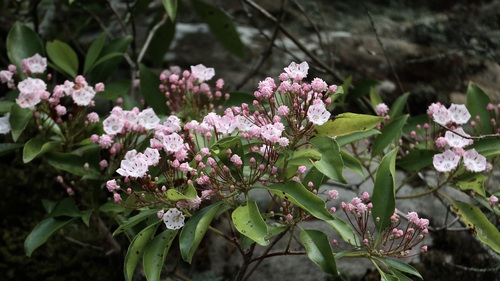
Mountain Laurel
Kalmia latifolia
Clusters of shell-pink buds open into porcelain-white cups brushed with blush. Each flower is patterned with burgundy pockets and curved stamens, set sharply against glossy, nearly black-green leaves at the wooded edge.
May · Research Grade
Field fact and source
Warm pink
Goat's Rue
Tephrosia virginiana
Pea-shaped flowers combine a creamy pink upper petal with a deeper rose keel, the warm color concentrated at the end of a slender stem. Fine hairs soften the many narrow leaflets to silvery green above dry grass and mottled woodland light.
May · Research Grade
Field fact and source
Smoke mauve · cream
Ramaria fumigata
Ramaria fumigata
A coral-like body rises in smoke-soft mauve, its crowded rounded towers tipped with ivory cream. The cool color seems nearly neutral until it meets the vivid moss wrapped around the fallen wood.
August · Research Grade
View the iNaturalist observationThe Appalachian spectrum
White & Cream
translucent white · soft white · ivory · cream
Ghost Pipe opens White & Cream in translucent pink-white, followed by the branching ivory of White Coral Fungus. Flowers and fungi carry the chapter through clear white, soft white, and warm cream.
Translucent pink-white
Ghost Pipe
Monotropa uniflora
Translucent ivory stems rise from russet leaf litter in waxy clusters, each one bent beneath a nodding, urn-shaped flower. Soft pink-beige shadows collect along the ridges and curled edges, while wet leaves, gray twigs, and dark soil deepen the surrounding floor.
Research Grade
Field fact and source
Ivory white
White Coral Fungus
Clavulina coralloides
A dense ivory body rises from blackened wood in hundreds of fine upright branches. Cream shadows deepen inside the coral-like mass, while wet leaf litter, splintered charcoal bark, and fresh green plants make the ivory crown the brightest form on the forest floor.
August
Field fact and source
Clear white
Mountain Camellia
Stewartia ovata
Held toward a shaft of sun, one white flower opens from a leafy twig, its cupped petals surrounding a dense burst of butter-yellow stamens. The hand, glossy deep-green leaves, and blurred gray stone below keep the bloom connected to the wooded slope where it was growing.
June · Research Grade
Field fact and source
Soft white
Multiflora Rose
Rosa multiflora
Loose clusters of blush-white roses fill the leafy canopy, each five-petaled flower opening around a ring of warm golden stamens. Fresh chartreuse leaves, arching green canes, and higher branches place the blush-white blossoms in a dense wall of growth.
May · Research Grade
Field fact and source
White with blush
Great Rhododendron
Rhododendron maximum
Bell-shaped flowers shade from pearl white to a light shell pink, their upper throats freckled with tawny green-brown spots. Thick evergreen leaves frame the close blooms, while the wider view returns the flower clusters to a dark creekside thicket.
June · Research Grade
Field fact and source
Clear white
Buttonbush
Cephalanthus occidentalis
One open flower head radiates hundreds of slender pink-white styles from a warm coral center, creating a delicate sphere of pins. Smaller ivory-green globes wait nearby among red stems and broad, deeply veined leaves striped with afternoon sun.
July · Research Grade
Field fact and source
Soft white
Downy Rattlesnake Plantain
Goodyera pubescens
Two slender flower spikes lean beside a gray tree trunk, each one lined with tiny cream-white blossoms and round buds. A fern-green leaf crosses the stems above wet copper litter, moss, and dark bark at the base of the tree.
Research Grade
Field fact and source
Warm ivory
Jellied False Coral Fungus
Sebacina schweinitzii
Short ivory branches rise in tight, waxy clusters, some blunt and clubbed, others divided like small antlers. Cream tips glow against russet leaves, thin green grass, dark soil, and the scattered stems of the hardwood floor.
July · Research Grade
Field fact and source
Cream
Eastern Cauliflower Mushroom
Sparassis spathulata
A cream-colored fruiting body billows from the leaf litter in a dense fountain of thin, curled ribbons. Warm beige shadows trace every translucent fold, while gray twigs, dark earth, mossy bark, and a tree trunk encircle the ruffled mass.
July · Research Grade
Field fact and source
Warm cream
Lynx Paw Oyster
Pleurotus levis
A warm cream cap projects from a dark split in the tree, its underside opening into ivory gills that sweep back toward the attachment point. Wider vertical views show the small fan against rough gray-brown bark, black hollow wood, lichen, and the green forest beyond.
Research Grade
Field fact and source
The Appalachian spectrum
Brown, Gray & Black
ochre brown · earth · stone · cool gray · charcoal · black
Warm brown gives way to earth and stone, then cool gray, charcoal, and black. The final photograph returns every color to the Appalachian landscape.
Charcoal
Old-Man-of-the-Woods
Strobilomyces strobilaceus
A near-black mushroom rises upright from luminous moss, its cap broken into ragged charcoal scales edged with silver gray. The same shaggy pattern continues down the thick ash-gray stalk, set against fern green, russet leaves, and a damp decaying log.
August
Field fact and source
Ochre brown
Cross-Veined Troop Mushroom
Xeromphalina kauffmanii
Dozens of ochre-brown caps climb a blackened stump on long, slender stems. The crowded shelves range from honey gold to cinnamon, exposing cream crossed gills and cream rims against charred wood, damp leaf litter, and a softly green forest.
August
View the iNaturalist observationBanded warm brown
Turkey-tail
Trametes versicolor
Velvety fans overlap along a fallen log in concentric bands of cinnamon, taupe, cool gray, and cream. Their finely fringed white rims curl into ruffled waves, and a side view reveals the thin layered shelves above silver-gray weathered wood.
August · Research Grade
View the iNaturalist observationTawny brown
Pink-Striped Oakworm Moth
Anisota virginiensis
Chocolate-brown wings spread across a hand, crossed by muted rose bands and marked with one clean white spot on each side. The plump abdomen glows pumpkin orange beneath the dusky wings, with fingertips and a blurred woodland edge setting its scale.
May
Field fact and source
Brown and tan
Velvet-Footed Tap
Tapinella atrotomentosa
A broad amber-brown cap rises above a thick, softly textured buff stalk, with smaller caps repeating the shape nearby. One low view reveals the dark underside, while wet oak leaves, pine needles, gray branches, moss, and deep woodland green surround the substantial mushroom.
August · Research Grade
Field fact and source
Earth brown
Common Earthball
Scleroderma citrinum
Two tawny spheres sit together in clear moving water, their leathery surfaces stippled with fine dark warts. Ripples bend reflected sky and branches around them, carrying highlights over submerged brown leaves, stones, and a diagonal creekside twig.
August
Field fact and source
Soft taupe-gray
Collared Earthstar
Geastrum triplex
Soft fawn-colored rays open across the leaf litter around a round, velvety taupe spore sac. The papery arms fold and crease like worn cloth, with dry oak leaves, gray sticks, and several smaller earthstars repeating the tender star shape nearby.
August
Field fact and source
Cool gray
Great Blue Heron
Ardea herodias
Balanced on a fallen trunk at the waterline, the heron folds slate-blue wings beneath a silver-gray back and lifts its rust-streaked neck toward the wooded bank. Exposed roots, mossy rock, tawny leaves, and reflected water make the bird part of the shoreline rather than a figure set apart from it.
April · Research Grade
Field fact and source
Black
Eastern Black Trumpet
Craterellus fallax
Inky black funnels curl through brilliant moss, their thin, wavy rims folding like dark fabric. Charcoal interiors, ash-gray outer surfaces, wet wood, pine needles, and tiny green leaves make the clustered mushrooms visible without softening their shadowy color.
August
View the iNaturalist observationBlack
Eastern Black Bear
Ursus americanus americanus
The bear appears as a deep black form at the far edge of a quiet cove, standing and then moving along the narrow shoreline. Charcoal fur is framed by silver-gray bare trunks, evergreen rhododendron, gray riprap, and blue-green water carrying long vertical reflections from the mountain slope.
March · Research Grade
Field fact and source
Silver · charcoal · stone brown
Striped Fishing Spider
Dolomedes scriptus
Long banded legs flatten across a submerged stone, repeating the charcoal, silver, and warm brown of the gravel below. In close view, white lines and smoky patches turn the body into a precise little drawing beneath clear water.
August
View the iNaturalist observationWhat the photographs taught me
Color in the mountains is never just a swatch.
The longer I looked, the more each color changed with the thing carrying it. Blue could sit deep in mushroom gills, flicker across a fish, or soften into four tiny petals. White could feel waxy, translucent, or lit from within. These are eight details that changed how I see Appalachian color—and what I bring back to the studio.
A red berry with two small beginnings.
Look closely at Partridgeberry and the fruit carries two tiny dimples—a trace of the paired flowers that came before it.
Both flowers have to be pollinated before one scarlet berry forms. Later, that bright red helps the fruit stand out against glossy green leaves and the dark forest floor.
Orange can mean bloom, fungus, or warning.
An Eastern Newt wears its brightest orange while traveling through the woods; as an aquatic adult, it settles into olive green.
The orange eft is easy to see and difficult to ignore, a warning carried in skin. Nearby, azalea petals, jewelweed, waxcaps, and Chicken of the Woods arrive at neighboring oranges in entirely different ways.
Autumn yellow was hiding inside the leaf.
When green chlorophyll fades, yellow and orange pigments that were already present finally become visible.
The same pigments help a living leaf manage sunlight. Across the mountains, yellow also appears in flower cells, mushroom flesh, pore surfaces, and thousands of overlapping butterfly scales—similar color, completely different surfaces.
A green lichen is a small shared life.
The broad green patch on a rock is not one organism working alone: a fungus makes shelter while algae inside use sunlight to make food.
That partnership becomes the greenshield spreading across the stone. Look closer still and a lichen can contain yeasts and bacteria too—a whole community flattened into what first seems like one quiet color.
U.S. Forest Service → · Missouri Department of Conservation →
Blue changes when the surface changes.
The Indigo Milk Cap makes its own deep blue. A sunfish flashes turquoise because tiny reflective layers in its skin catch and return the light.
That is why fish color seems to move as the body turns: blue slips into olive, gold, or green with the angle. Flowers reach powder blue and violet through pigments and petal structure, while water and sky add their own reflected color around everything.
A flower looks different to a bee.
Bees see ultraviolet as well as blue and green, so a bloom can carry markings that are invisible to me.
Petal shape, surface, scent, nectar, background, and angle all become part of the invitation. What I call violet is only one view of a much larger signal passing between flower and visitor.
Floral optics and pollinator vision → · Flower-color chemistry →
White is full of small shadows.
A white petal can look luminous because light keeps meeting cell walls and tiny air spaces, then scatters back toward the eye.
Change the thickness or surface and white becomes waxy, papery, translucent, or warm cream. Veins, curled edges, shaded centers, and reflected green from nearby leaves keep it from ever being blank.
Dark color can protect a fungus.
Some fungi build melanin into their cell walls, making the dark surface part color and part protection.
It can help cells withstand drying, radiation, temperature swings, and chemical stress. Elsewhere, darkness comes from black fur, wet bark, dense spores, deep water, or simple shade—each with its own kind of black.
The field record and the artwork
The colors return to the studio with me.
These photographs began as references for my artwork. They now form their own record of Appalachian color, while the same flowers, water, stone, wildlife, and forest structure continue into the work I make for Lakehouse Portrait Co.
Keep looking with me
The palette is still growing.
New encounters will add another shade, season, habitat, or closer view to this Appalachian field record.
Browse the Appalachian Field Guide
See how the record is built
Explore my complete iNaturalist record
All field photographs and field notes by Rachel Stepek · Field exploration and discoveries with Nathan Stepek