
Photographed fungi encounters
Fungi
Mushrooms and other fungi I documented through caps, pores, gills, attachment points, substrate, and wider forest setting.
A curated fungi field guide
Caps, gills, pores, stalks, and what they grew from.
Browse by habitat or search by common or scientific name. Know the color before the name? Browse the Color Guide →
Blue-green Cracking Russula
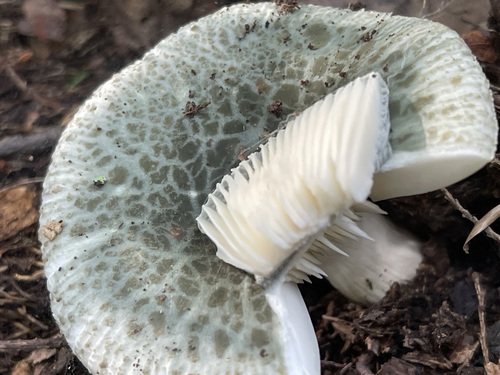
Russula parvovirescensA broad sage-blue cap breaks into light islands like old glaze crazing across a ceramic surface. One torn wedge turns upward to reveal clean ivory gills, sharpening the contrast between the mushroom’s cool, weathered color and the dark soil and brown leaf litter around it.
See this entry in the Color Guide →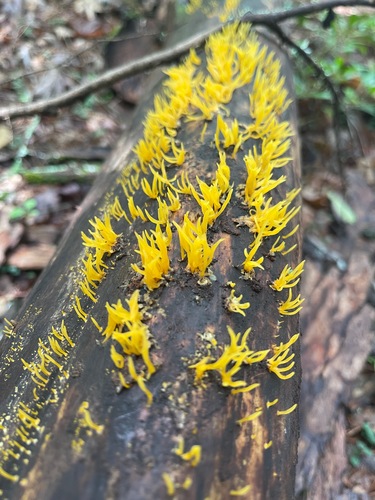
Club-Like Tuning Fork
Calocera corneaHundreds of egg-yolk-yellow clubs branch into tiny forks across a slick, almost black log. The upright tips resemble miniature antlers or flames, spreading in loose colonies through beads of moisture, bare wood grain, and shadow.
See this entry in the Color Guide →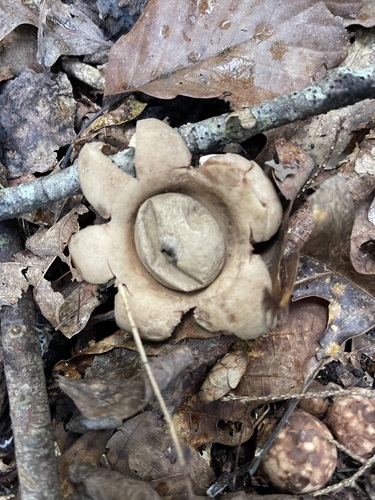
Collared Earthstar
Geastrum triplexSoft fawn-colored rays open across the leaf litter around a round, velvety taupe spore sac. The papery arms fold and crease like worn cloth, with dry oak leaves, gray sticks, and several smaller earthstars repeating the tender star shape nearby.
See this entry in the Color Guide →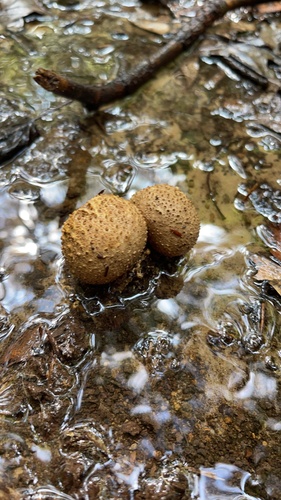
Common Earthball
Scleroderma citrinumTwo tawny spheres sit together in clear moving water, their leathery surfaces stippled with fine dark warts. Ripples bend reflected sky and branches around them, carrying highlights over submerged brown leaves, stones, and a diagonal creekside twig.
See this entry in the Color Guide →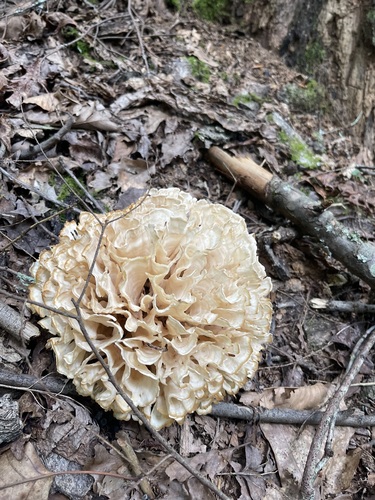
Eastern Cauliflower Mushroom
Sparassis spathulataA cream-colored fruiting body billows from the leaf litter in a dense fountain of thin, curled ribbons. Warm beige shadows trace every translucent fold, while gray twigs, dark earth, mossy bark, and a tree trunk encircle the ruffled mass.
See this entry in the Color Guide →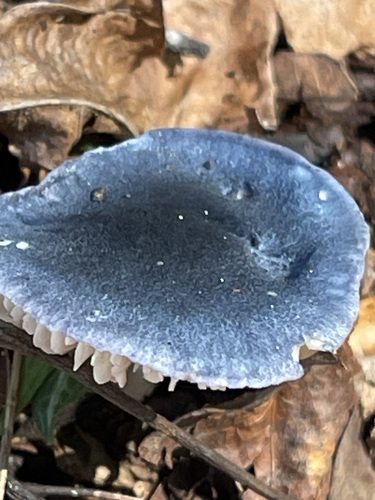
Entoloma indigoferum
Entoloma indigoferumA round cap appears painted in stormy denim, darkest at the softly depressed center and dusted with tiny silver flecks. Low side views reveal warm gray-pink gills and a slim blue-gray stalk, while twigs, oak leaves, and one small green seedling return the mushroom to its modest woodland scale.
See this entry in the Color Guide →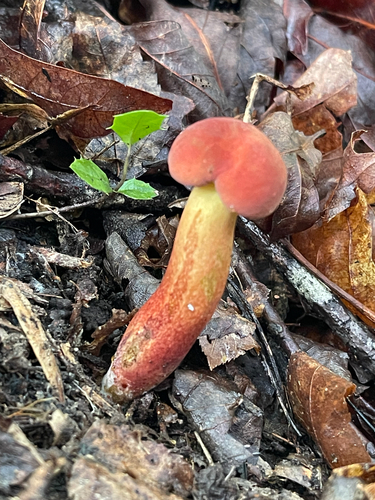
Field Bolete
Hortiboletus campestrisThe rounded cap is a soft red-orange, matte and almost velvety, above a stalk that begins golden yellow and deepens through rust to wine red at the base. Curled wet leaves, dark wood, and one bright green seedling gather around the upright mushroom.
See this entry in the Color Guide →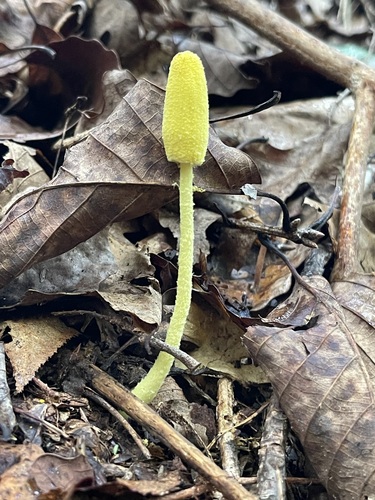
Fragile Dapperling
Leucocoprinus fragilissimusA pointed lemon-yellow cap balances on a stem nearly as thin as grass. The upright views emphasize its clean, high-key color among russet leaves; turned on its side, the mushroom reveals delicate ivory gills and a papery cap margin.
See this entry in the Color Guide →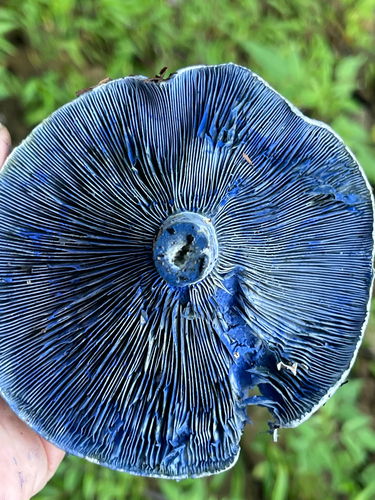
Indigo Milk Cap
Lactarius indigoTurned upward, the broad gills radiate in saturated indigo, shifting from silvery blue at the rim to ink-dark cobalt where they gather around the stalk. The cap above is a powder blue among fern stems and wet leaves. Broken edges release blue milk, staining the damaged gills an even deeper blue.
See this entry in the Color Guide →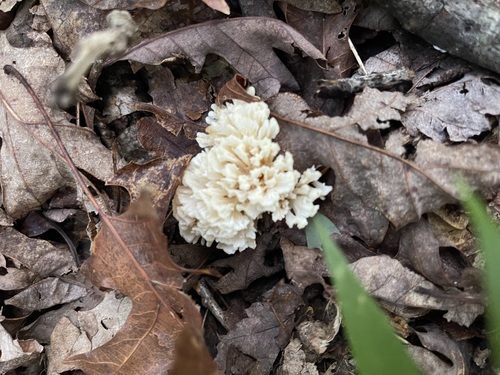
Jellied False Coral Fungus
Sebacina schweinitziiShort ivory branches rise in tight, waxy clusters, some blunt and clubbed, others divided like small antlers. Cream tips glow against russet leaves, thin green grass, dark soil, and the scattered stems of the hardwood floor.
See this entry in the Color Guide →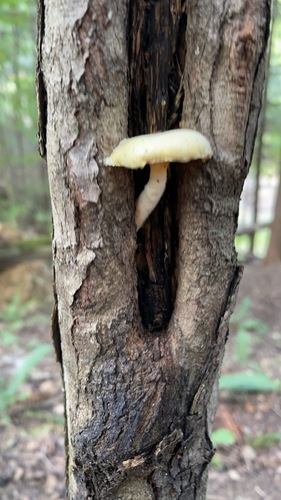
Lynx Paw Oyster
Pleurotus levisA warm cream cap projects from a dark split in the tree, its underside opening into ivory gills that sweep back toward the attachment point. Wider vertical views show the small fan against rough gray-brown bark, black hollow wood, lichen, and the green forest beyond.
See this entry in the Color Guide →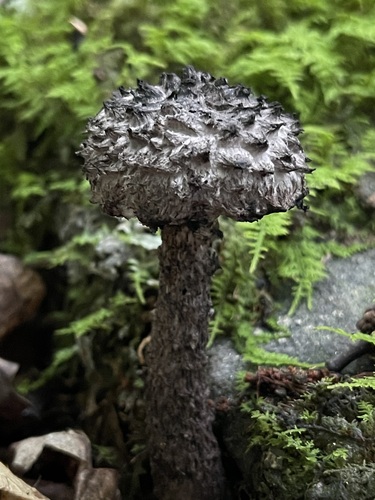
Old-Man-of-the-Woods
Strobilomyces strobilaceusA near-black mushroom rises upright from luminous moss, its cap broken into ragged charcoal scales edged with silver gray. The same shaggy pattern continues down the thick ash-gray stalk, set against fern green, russet leaves, and a damp decaying log.
See this entry in the Color Guide →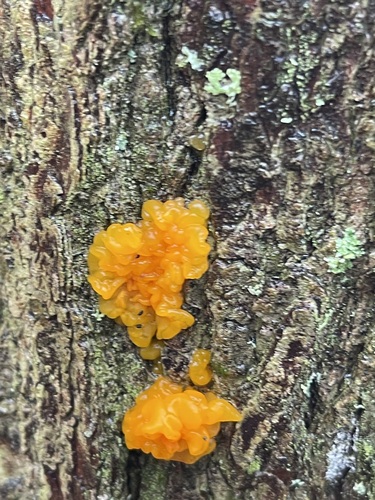
Orange Jelly Spot
Dacrymyces chrysospermusMarigold-orange folds gather on rain-darkened bark like small translucent ruffles. Their glossy, gelatinous surfaces catch the light at close range, while the wider view reduces them to brilliant pinpoints on a slender charcoal-brown trunk.
See this entry in the Color Guide →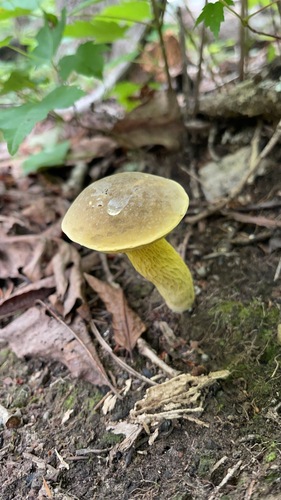
Ornate-Stalked Bolete
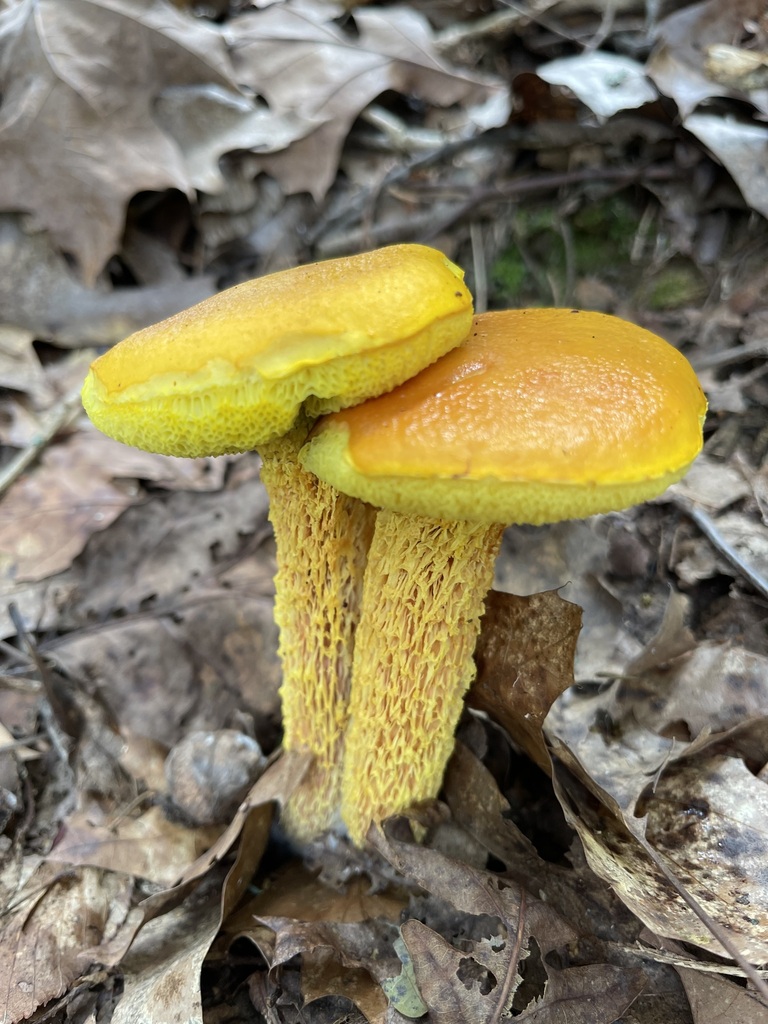
Retiboletus ornatipesThe late-August mushroom stands whole above dry leaves: a smooth sunflower-yellow cap balanced on an even brighter stalk wrapped in a deeply raised gold network. The earlier hand-held view turns the cap over to show a fine, evenly yellow pore surface.
See this entry in the Color Guide →July observation → · Paired mushrooms → · Research Grade return →
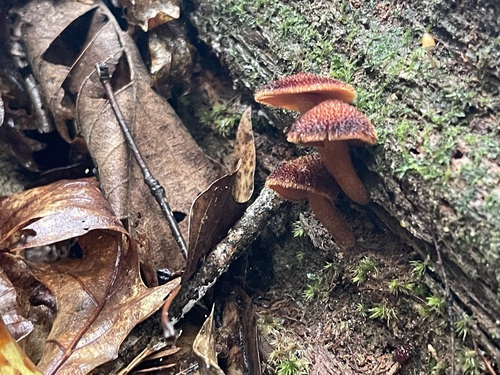
Powder-Scale Pholiota
Flammulaster erinaceellusSmall cinnamon-red caps cluster from the side of a fallen log, their darker centers densely dusted with upright scales. The caps thin toward translucent ember-orange rims above rusty gills, wet brown leaves, and a fine green film of moss.
See this entry in the Color Guide →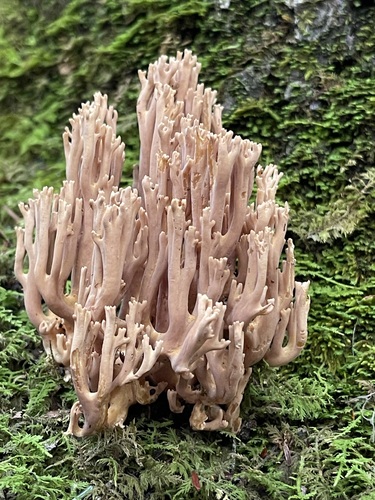
Ramaria fumigata
Ramaria fumigataA many-branched coral rises in smoke-soft mauve. Its rounded stems split and resplit, crowding together before they finish in cream tips. Bright moss wraps the wood beneath it; a wider view lets the delicate coral shrink back into the green length of the fallen trunk.
See this entry in the Color Guide →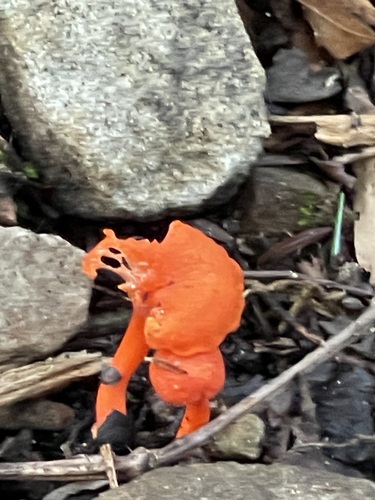
Red Chanterelle
Cantharellus cinnabarinusA tiny cinnabar-red chanterelle lifts a curled, irregular cap above a short orange stalk. Apricot ridges appear beneath the folded edge, while gravel, splintered sticks, gray stones, and dark soil make the small flare of color easy to measure.
July observation → · August observation →
See this entry in the Color Guide →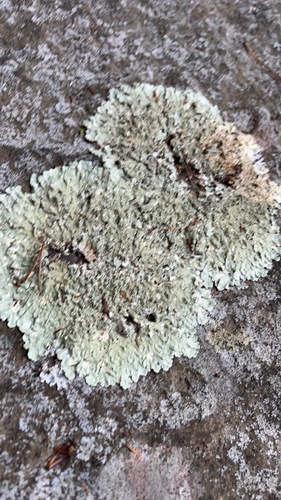
Rock Greenshield Lichen
Flavoparmelia baltimorensisA broad patch of silver-sage lobes spreads over charcoal stone, its edges curling into soft, shieldlike ruffles. The center is rough with clustered bumps and gray-green granules, giving the lichen a dense texture against the smoother rock.
See this entry in the Color Guide →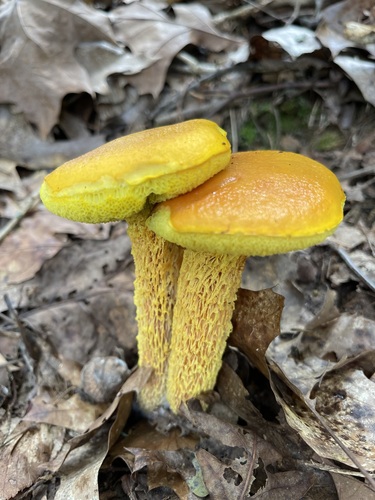
Shaggy-Stalked Bolete
Aureoboletus betulaOld-gold caps shade toward ochre-orange, their rims lit from below by a dense lemon-yellow pore surface. The thick, curving stalks are wrapped in a deeply raised yellow network streaked with rust and red, almost like open latticework. Moss, silver-green lichen, oak leaves, and twigs crowd the low shelter around them.
See this entry in the Color Guide →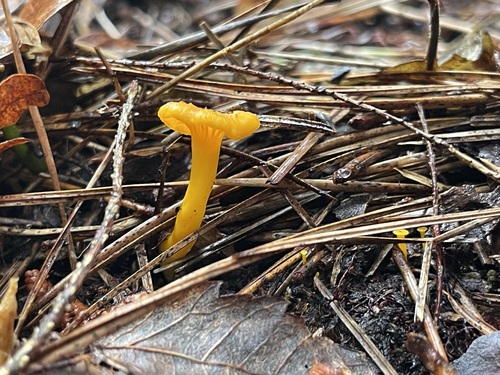
Small Yellow Mushrooms
HydnaceaeOne egg-yolk-yellow mushroom rises cleanly through crossed pine needles, its wavy cap opening above a narrow golden stem. Blunt ridges run beneath the cap while wet brown leaves, black soil, and scattered orange fragments repeat the color across the forest floor.
See this entry in the Color Guide →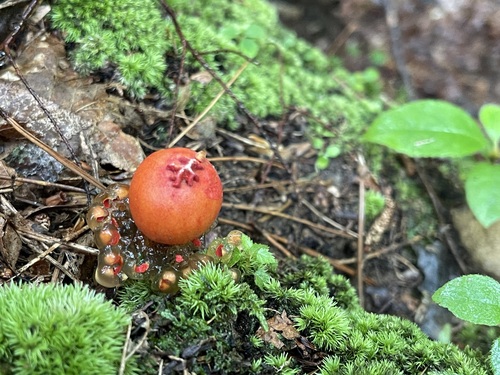
Stalked Puffball-in-Aspic
Calostoma cinnabarinumRuby-red spore sacs rise from translucent amber bases that gleam like wet resin among bright moss. One mature globe opens in a dark, star-shaped mouth; other views reveal a tall stalked form, crowded scarlet colonies, and an ivory immature cluster whose gelatinous lobes are still tightly folded.
See this entry in the Color Guide →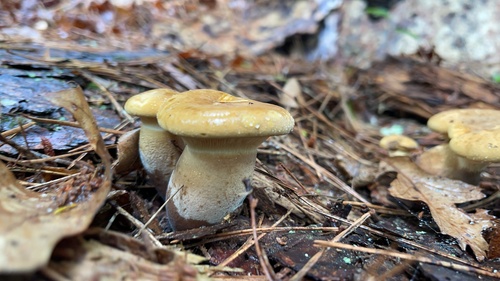
Velvet-Footed Tap
Tapinella atrotomentosaA broad amber-brown cap rises above a thick, softly textured buff stalk, with smaller caps repeating the shape nearby. One low view reveals the dark underside, while wet oak leaves, pine needles, gray branches, moss, and deep woodland green surround the substantial mushroom.
See this entry in the Color Guide →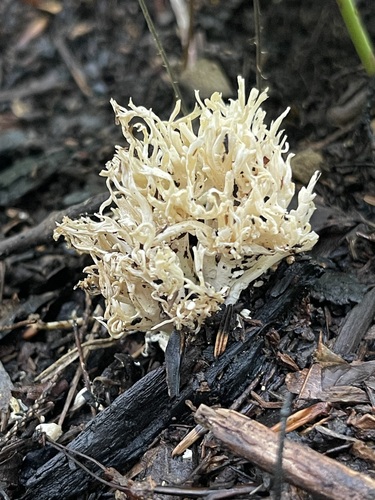
White Coral Fungus
Clavulina coralloidesA dense ivory body rises from blackened wood in hundreds of fine upright branches. Cream shadows deepen inside the coral-like mass, while wet leaf litter, splintered charcoal bark, and fresh green plants make the ivory crown the brightest form on the forest floor.
See this entry in the Color Guide →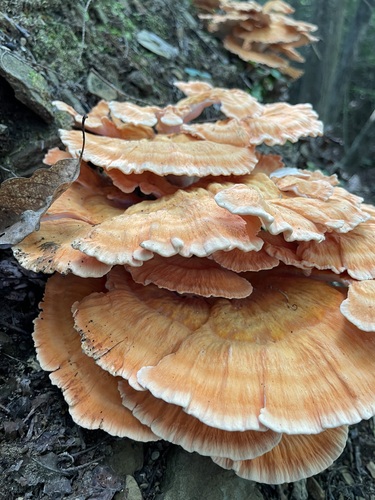
White-Pored Chicken of the Woods
Laetiporus cincinnatusBroad salmon-orange shelves stack into rippling rosettes, each fan banded with peach and finished by a narrow cream edge. Close views reveal velvety upper surfaces and a chalk-white pore layer; on the steep wooded bank, light passes through the thinner margins above dark roots, stone, and moss.
June observation → · August observation →
See this entry in the Color Guide →