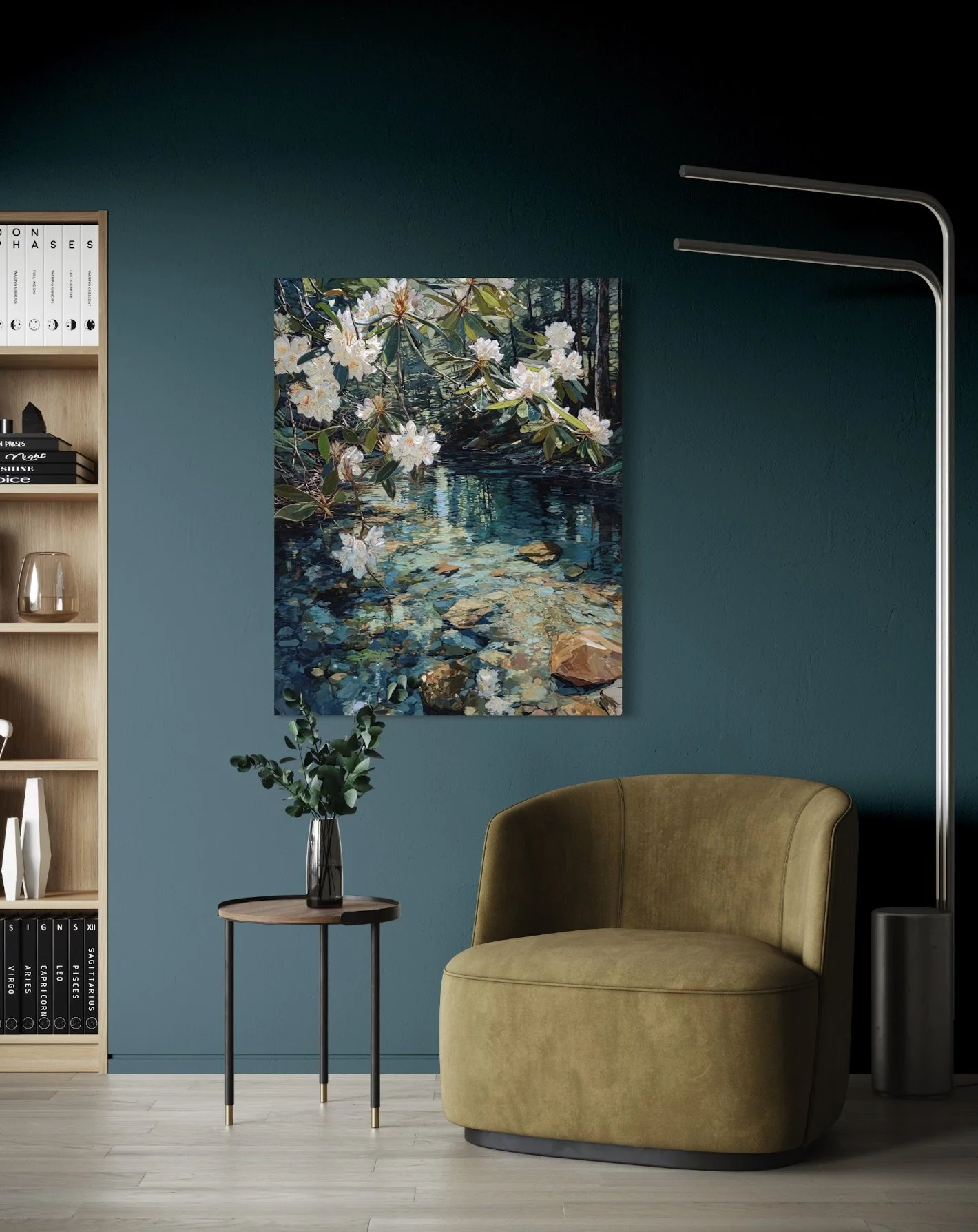
Lake Art for Living Rooms: How One Statement Piece Can Carry Color, Memory, and Calm
A living room needs one piece with a reason
Choose it because it reminds you of something. Choose it because you love the colors. Choose it because of the way it makes you feel.
A statement piece should be large enough for the wall and personally meaningful to the people who live with it.I have stayed in vacation rentals with almost no artwork, and I have stayed in places where the walls gave me something interesting to notice. It changes the stay. Without color or art, a room can feel generic, empty, too new, or not quite lived in yet. With the right piece, the room gives your eye somewhere good to land.
That is true at home, too. Our living room felt more inhabited after I hung large artwork in it. It became less like a room we passed through and more like a place where our family actually made memories. The art did not fix the room by matching the pillows. It changed how the room felt to be in.
Look at the wall and ask, “What color, subject, or memory belongs here?”
Maybe it needs warmth. Maybe it needs one big calm thing. Maybe it needs your favorite blue-green water, a fish, a heron, a late sun, or something with enough life in it to make the room feel less empty.
Four ways to recognize the right piece.
The most useful living room art is not always the safest art. It is the piece with a reason behind it. If you keep returning to the same color, the same kind of water, the same animal, or the same quiet feeling, that is not random. That is usually the room telling you what it needs.
Start with the wall that matters most.
Every living room has one wall that does more visual work than the others. It might be over the couch, across from the main seat, beside the fireplace, above a console, or in the part of the room that shows up first in photographs.
That wall is where I would start. Not with the smallest safe piece. Not with something generic because it is easy. Start with the place where one strong canvas could change how the whole room reads.
If you are choosing for your own home, start with the wall you see every day. If you are choosing for a rental, start with the wall guests see first. If you are choosing as a decorator, start with the wall that can carry the palette for the rest of the room.
Choose by color first
Your favorite colors are allowed to lead.
A living room does not have to be built around beige just because beige is easy. If the colors you love are lake green, deep blue, copper water, warm yellow, soft lavender, pine shadow, or flower color, those are real design directions.
This is one reason lake art can change a room quickly. It brings in color that already feels natural: water color, sky color, bank color, plant color, wildlife color. It can make a room feel calmer and more considered without flattening it into showroom neutrality.
For decorators, that gives the room a palette. For homeowners, it gives the room memory. For rental owners, it gives guests something specific to remember.
Warm color
Sunset color, flowers, yellow light, and soft distance can make a room feel more welcoming without adding clutter.
Quiet color
Blue-green water, reflected light, and shaded banks can settle a room that already has a lot going on.
Living color
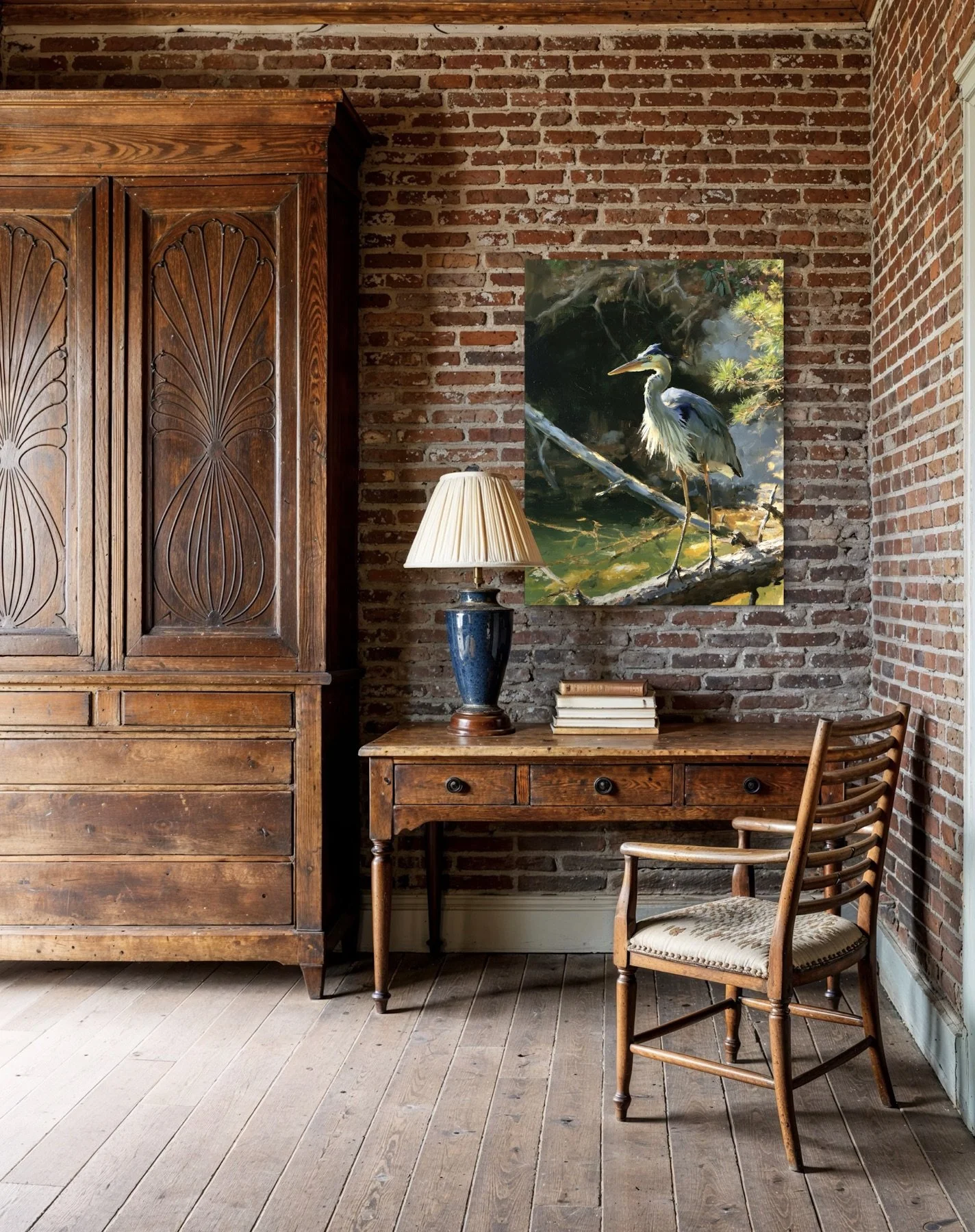
Fish, herons, botanicals, and waterline details give the room something new to notice.
Then choose the subject that suits the room.
This is where the piece itself matters. A fish painting moves differently than a heron. Reflected light feels different from a botanical. A warm evening lake scene does a different job than a deep green cove.
If the room needs energy, look for water movement or fish. If it needs quiet, look for reflected light. If it needs a stronger focal point, choose a larger canvas with a clear subject. If the room feels too polished or too new, choose something with a little wildness in it.
The piece does not have to explain your whole life. It just needs to feel like something you would keep noticing: the color of water you love, the kind of bank you remember, the bird that makes the room pause for a second, the flower color that makes everything feel more alive.
 High Top Evening Daisies
Choose this when the room needs warmth, light, flowers, and a softer way into lake color.
High Top Evening Daisies
Choose this when the room needs warmth, light, flowers, and a softer way into lake color.
 Blue-Gold Stillness
Choose this when the room needs quiet water, reflection, and a calmer blue-gold palette.
Blue-Gold Stillness
Choose this when the room needs quiet water, reflection, and a calmer blue-gold palette.
 Great Blue Heron on Lake Keowee
Choose this for a still, watchful wildlife piece that can serve as the room’s focal point.
Great Blue Heron on Lake Keowee
Choose this for a still, watchful wildlife piece that can serve as the room’s focal point.
 Smallmouth Bass in Clear Water
Choose this when the room needs movement, clear water, and a nod to fishing without a sign on the wall.
Smallmouth Bass in Clear Water
Choose this when the room needs movement, clear water, and a nod to fishing without a sign on the wall.

Scale matters
A main wall usually needs more confidence than people think.
If the living room wall is large, the art should not be timid. Over a couch, mantel, console, main gathering wall, or protected outdoor living room, a larger canvas often feels calmer than a small piece floating in too much space.
For a large sofa wall, look at 40 x 20, 48 x 24, or 60 x 30 inch horizontal canvases. For a taller narrow wall, a vertical 24 x 36 or 24 x 48 inch canvas can feel strong without needing a lot of width. For a reading corner, small wall, or side table moment, 16 x 20, 18 x 24, 20 x 10, or 30 x 15 can be enough. Size availability varies by artwork, so use the product page and size guide together.
Ready-to-hang canvas makes this decision easier.
This is part of why I like canvas so much for living rooms. It arrives stretched, gallery-wrapped, and ready for the wall. You can frame it if you want to, and canvas can look beautiful framed, but it does not require a separate frame hunt before the room can move forward.
Most of the canvases have a 1.25 inch gallery profile, so they sit off the wall with finished wrapped edges. For a living room, that matters. The wrapped profile makes the canvas feel finished on the wall before any optional framing.

If the room feels almost there, start with one strong piece.
You do not have to solve the whole room at once. Choose the wall that matters most. Choose the colors you actually want to live with. Choose a piece with enough scale to feel settled on the wall.
That is the useful thing about lake art in a living room. It can bring water, wildlife, plants, rocks, shadows, sunsets, and memory into the room without asking the room to become a theme.
It just gives the space something worth gathering around.
Keep exploring
More help choosing lake art for real rooms.
These pages go deeper into lake house wall art, ready-to-hang canvas, rental rooms, and the broader Lakehouse Portrait Co. approach to lake art for real spaces.