
Why I Started Painting Lake Houses From the Water
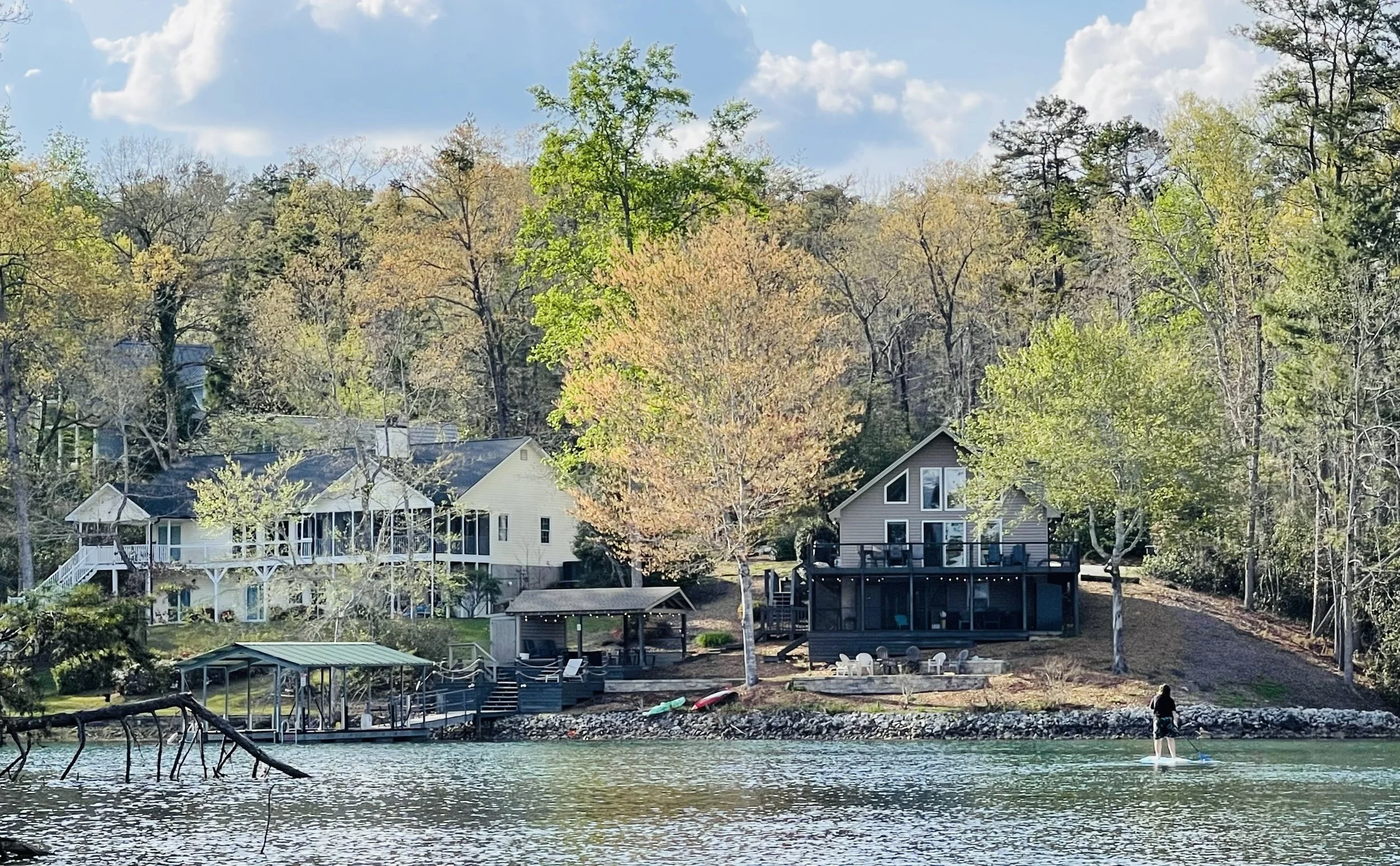
Lake Keowee, heading back in. I remember us easing off the throttle when this came into view—the kids already out there, completely in their own world. Nothing staged, nothing called out. Just one of those quiet, real moments that somehow holds more than all the big ones.
I didn’t come up with this idea at a desk.
It happened out on the water—like most of the things that matter to me do.
We were on Lake Keowee, just drifting around in our bass boat. My husband was fishing. I was… sort of fishing. Mostly just looking around.
And I kept noticing the houses.
Not just that they were big or beautiful—though they were—but the way they were designed. The way they faced the water. The way the light hit them in the evening. The way everything about them felt intentional from that angle.
It was like they weren’t just built on the lake…
They were meant to be seen from it.
And I remember thinking, almost all at once—
This is the view.
Not the driveway. Not the front door.
This.
That perspective from the water is where the feeling lives.
And once I saw it, I couldn’t unsee it.
⸻
I’ve always had a habit of painting things in my head.
It’s hard to explain, but when I’m looking at something, I’m not just seeing it—I’m already adjusting the light, simplifying the composition, deciding what matters and what doesn’t. It’s just how I’ve learned to see over time.
So as we floated there, I started mentally turning those houses into paintings.
What I would keep. What I would soften.
How the light could feel warmer.
How the whole scene could feel just a little more like what it felt like to be there.
And that’s when the second part clicked.
Not just that it would make a beautiful painting…
But that people would want it.
Because if you’ve chosen a home like that—on the water, positioned just right—you already understand that view. You’ve already invested in it. You’ve lived in it.
You don’t just want a picture of your house.
You want that feeling reflected back to you.
⸻
At the same time, I knew something else.
Most people would never go through the process of commissioning something like that.
It sounds complicated. Expensive. Time-consuming. Like you’d need the perfect photo, or a lot of back-and-forth, or some kind of art-world knowledge to even get started.
And I didn’t want that.
I wanted it to feel simple.
Something you could start with a photo already on your phone—taken from the boat, or the dock, or just one of those moments where the light was right and you paused long enough to notice it.
Something that arrives finished. Framed. Ready to hang.
No extra steps. No friction.
Because the feeling is already there.
My job is just to hold onto it.
⸻
My home lake is Laurel River Lake.
It’s very different.
There are no houses on it, and I love that. It feels wild in a way that’s getting harder to find. When you’re out there, you don’t feel like you’re looking at someone’s property—you feel like you’re discovering something.
Every cove feels a little unexplored.
Every turn feels quiet in a way that settles you.
I’ve seen all sorts of animals there. Bald eagles. Raccoons along the shoreline. Chipmunks darting in and out of the rocks.
It’s one of my favorite things—just noticing what’s there, without disturbing it. Being part of it, but not interrupting it.
That kind of place gives you a different kind of feeling.
But Keowee showed me something else.
It showed me how people create meaning in a space of their own.
⸻
Because lake houses—especially the ones built with intention—aren’t just houses.
They’re where people go to live differently.
I see it in my own family every time we’re on the water.
The kids spread out in their own ways. One’s fishing. One’s throwing rocks. One’s exploring the shoreline. Someone’s on a paddleboard. And somehow, even though everyone’s doing something different, it all feels more connected.
There’s less tension. More presence.
More of those small, unplanned moments that end up mattering more than you expected.
And I think people spend a lot of their lives working toward that.
Not just the house itself—but the feeling of being there. The pace of it. The way it changes how your family interacts. The way it lets you exhale a little.
⸻
That’s why I don’t really think of these as “just paintings.”
What I’m creating is a way to hold onto something that already exists in your life.
A way to bring that perspective—the one from the water, the one that holds the most meaning—into your everyday space.
So when you’re back home, or even just in a different season of life, it’s still there.
Not in a nostalgic way.
In a steady, grounding way.
Like a quiet reminder: This mattered. This still matters.
⸻
I do have formal training in painting, and that matters in the process—how I see light, how I simplify composition, how I build something that feels balanced and intentional.
But more than anything, what matters is that I understand what I’m looking at.
I know what that view feels like.
I know what it’s like to sit in a boat at the end of the day and just take it in. To notice the way the house looks from the water. To feel that mix of pride, peace, and something a little harder to name.
That’s the part I don’t want to lose.
⸻
People work for years to earn that kind of space in their life.
The house. The time. The ability to be there with the people they love.
So when I take a simple photo—sometimes just one you snapped without thinking—and turn it into something finished, framed, and lasting…
It’s not about upgrading the image.
It’s about recognizing what was already there.
Validating it.
Confirming it.
Giving it a place to stay.
⸻
If you already have a lake-view photo you love—the kind you took without overthinking it—you’re already closer than you think.
That’s usually where the best pieces start.
—Rachel
